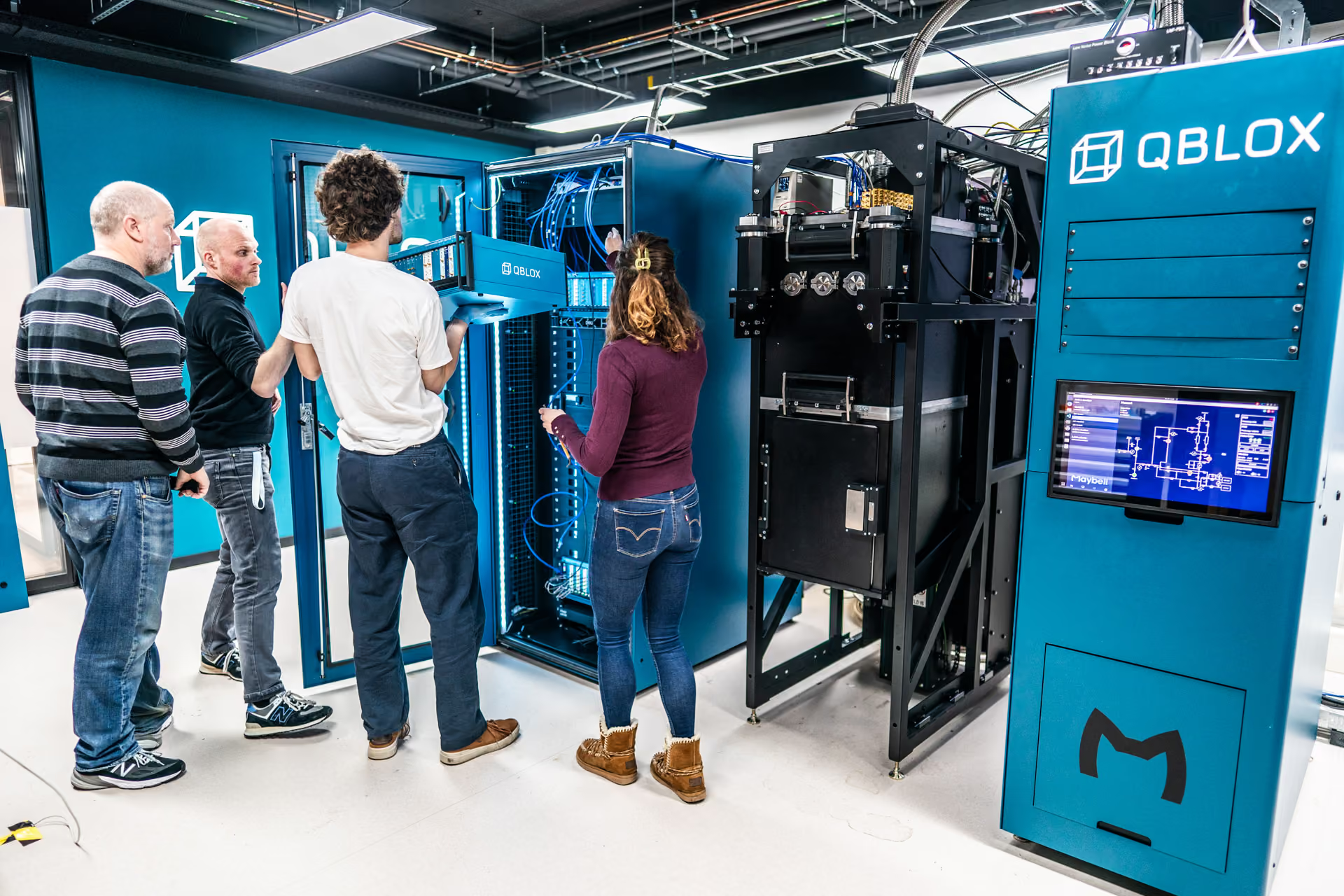
Every major computing technology has followed the same pattern. The hardware advances first. The people who operate it follow later. Quantum computing has reached that stage.
The belief
What mattered
Takeaway
Computers are for mathematicians and a handful of institutions.
1960s–70s
Mainframes
Exposure to computing concepts. Shared infrastructure. Early computer literacy - not job-specific skills.
The value wasn't training computer scientists. It was normalizing computing
Networking is niche. The web won't affect most jobs.
1980s–90s
Internet & Networking
Hands-on labs. Broad exposure across disciplines. Builders, not just experts.
The internet workforce existed before the business case was obvious.
Quantum is only for physicists. Industry adoption is years away.
NOW
Quantum Computing
Early access to real control stacks. Hands-on familiarity with how quantum systems actually run.
The bottleneck won't be qubits. It will be people.
Quantum voices
"If there's some course you're interested in, in some area of abstract math or computer science that doesn't look at all like it would be useful for quantum computing — go ahead and take it. Because at some point, this area is going to be important for quantum computing. And when that happens, you will be the only person in the field who has the requisite knowledge."
Peter Shor — Massachusetts Institute of Technology
"I think everybody is going to have to have the ability to zoom out of their prospective expertise and have an understanding of what's going on in other spaces. We still need those experts. At the same time everybody needs some situational awareness."
"I would say that's the most important thing that we need: we need these future most talented scientists around to want to be working in this field. And why wouldn't they want to be?"
Charles (Chuck) Black — Brookhaven National Laboratory
"In some future, people who are designing transistor chips don't need to be semiconductor physicists. It's been abstracted to a point where I can still design a circuit with some rules of thumb, engineering. This is what we have to do in quantum."
William D. Oliver — Massachusetts Institute of Technology
“It's a little bit less about the science. We're remarkably optimistic, but finding the right number of qualified workforce people just in general in a field that's moving so fast is a major challenge…ultimately it might be the biggest obstacle.”
"The miraculous feature of how we do this kind of research in the US is simultaneously training the workforce to work at the frontiers of knowledge through graduate students and postdocs. Both academia and industry need each other and will continue to."
"I was teaching for many years... the numbers grew from like 15, 20 to like hundreds. And now we're at like 350, right? For our introductory quantum classes, you would see a very broad spectrum of students from engineering disciplines."
"Increasingly, people would also like to be able to hire some undergrads who already have some of the skills they need. You don't just want to be hiring PhD scientists. How can we help to create the types of hands-on courses and experiential learning so that we're giving students at a younger age some of the skills they would need such that they can go straight with a bachelor's degree and start working in a quantum company."
"There are excellent undergrads now in quantum, like in Sherbrooke, for example, specifically on quantum engineering, master's degrees can get a job into a quantum startup with a master's degree, and it's very valuable. Something I could not do 40 years ago but that you can do now."
Qblox builds the control and readout electronics that operate quantum processors. That position gives a direct view of where the workforce gap is most acute: the people who keep quantum hardware running day to day.
#1
The shortage concentrates in one tier.
The gap is across engineers, technicians, and systems integrators who operate and maintain quantum hardware without holding a research doctorate.
#2
Working hardware teaches faster than theory does.
Reading about a quantum system and simulating one only go so far. Working on real, physical hardware is what actually builds the skill.
#3
This is a structural gap, not a temporary one.
The constraint is the training pipeline itself: the near-absence of laboratory-based, engineering-oriented instruction where the industry needs it most.
#4
Increasing early exposure is what will grow the whole quantum workforce.
Growing that early exposure is what grows the whole workforce, not only its most advanced roles. Somebody has to become curious about quantum computing before they can become skilled at it.
Why this initiative matters to Qblox
Qblox builds the control and readout electronics that operate quantum processors. That position gives a direct view of where the workforce gap is most acute: the people who keep quantum hardware running day to day.
Curriculum partnerships.
A curriculum that moves learners from hardware fundamentals through system automation to advanced, industrial-grade control, built directly into existing engineering and technical programmes rather than bolted on as an elective.
Lab access and emulation.
Labs that scale alongside an institution's ambition, from foundational few-qubit systems to full industry-scale hardware, all built on the same control electronics a learner will use on the job.
Instructor enablement.
Training and materials for educators who are not quantum specialists themselves, but want to give their students an early foothold in the field.
Workforce-board collaboration.
Qblox is a named hardware partner in regional testbeds built with workforce boards and economic-development organisations, extending hands-on access to institutions that could not build a lab alone.
“Give a student access to real hardware early enough and something shifts. They stop treating quantum computing like a subject in a textbook and start treating it like a job they could actually have. That shift is worth investing in."
Daphné Zinetti
Program Manager for Global Workforce Development, Qblox
Who we're building this with.
This is a workforce-readiness initiative aimed at the group the industry needs most: the engineers and technicians who will install, calibrate, and run quantum hardware.
Undergraduate and Masters students
Community colleges and Technical Institutes
Workforce boards and economic-development organizations
Existing STEM programs
Industry employers
Let's Build the Quantum Workforce, Together
If your organization is exploring how to build quantum talent, get in touch.
Quantum workforce development is the effort to train engineers, technicians, and systems integrators who can build, calibrate, and operate quantum computing hardware, not only researchers who study the underlying physics.
Why is there a shortage of quantum talent?
Quantum computing has moved from research into industry faster than education systems have adapted. Most existing training routes were built for physics researchers, leaving a gap in the hands-on, engineering-level skills the industry now needs.
What is Qblox doing about the quantum workforce gap?
Qblox works with universities, national laboratories, and industry partners to give students and engineers hands-on experience with real quantum control hardware, contributing to the technical workforce the industry needs.
How can my institution work with Qblox on workforce development?
Institutions interested in a workforce development partnership can contact Qblox directly through its website.



%20Black.avif)