
LINQ
Fast Scalable Feedback
For Quantum Error Correction And Advanced Qubit Operations
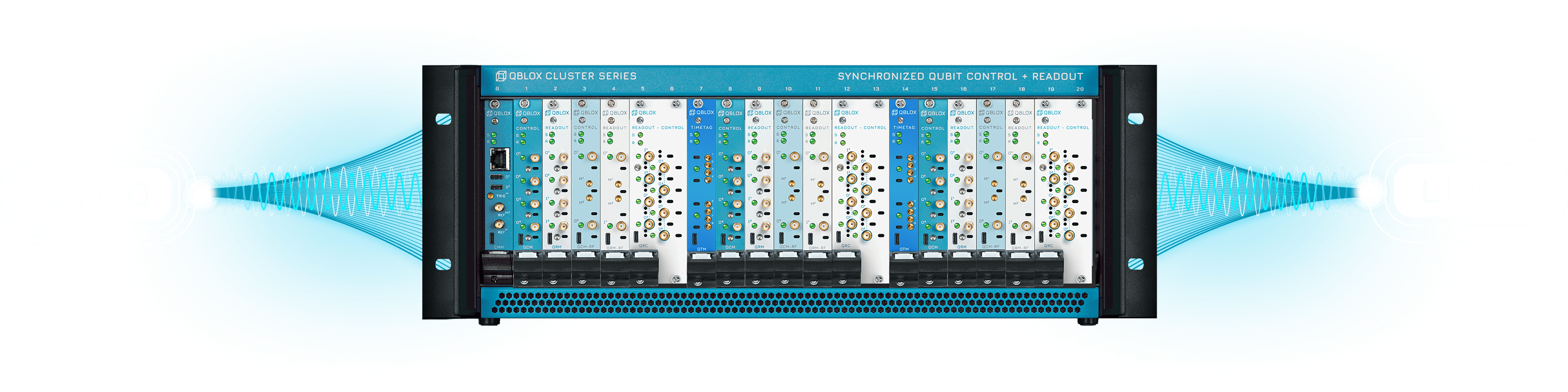
LINQ is the deterministic communication network inside the Qblox Cluster. It connects up to 120 Q1 sequence processors per mainframe, allowing measurement data and conditional triggers to be shared between sequencers, within or across modules, with bounded latency and no host computer.
TALK WITH A SPECIALIST
Built for fast, mainframe-wide feedback

< 650 ns FOR ANY CONDITIONAL OPERATION ACROSS THE CLUSTER
SIMULTANEOUS MULTI-QUBIT READOUT
ALL-TO-ALL BRANCHING
REAL-TIME PARAMETER UPDATES ACROSS UP TO 20 MODULES

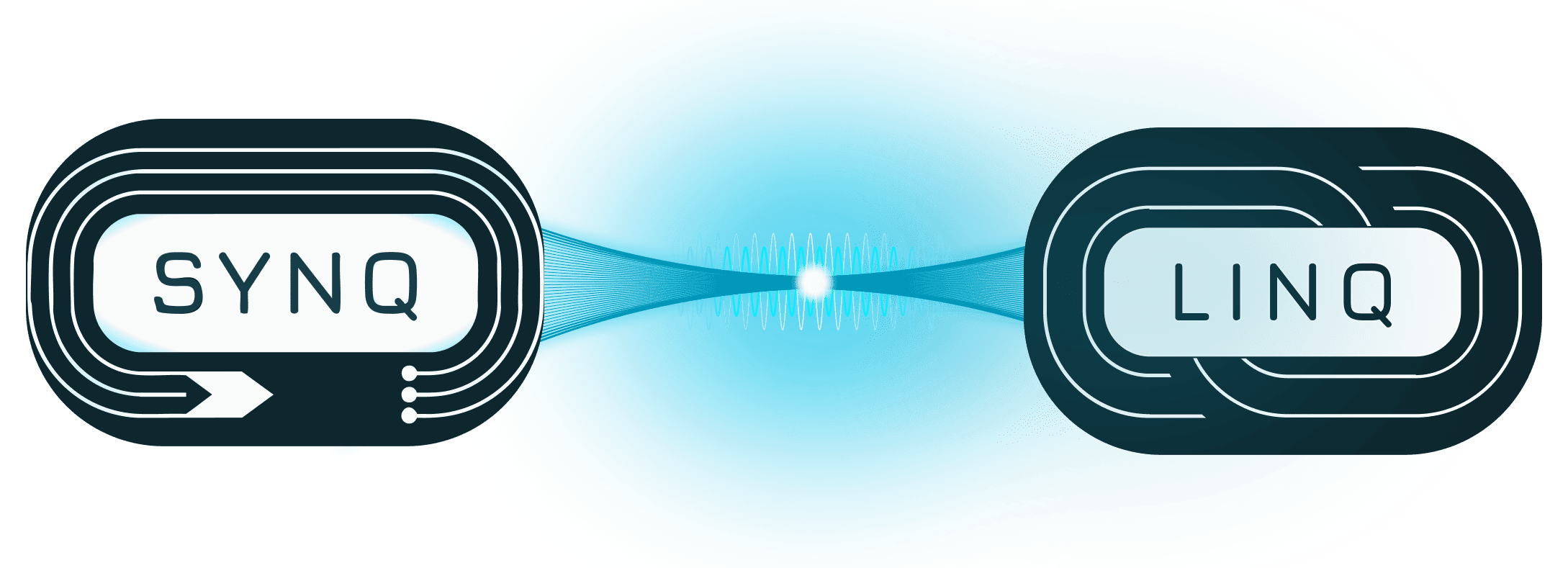
Paired with the synchronisation layer SYNQ
LINQ forms the deterministic backbone for feedback-driven quantum operations at scale.
LINQ at a glance:
FEEDBACK LOOP LATENCY
< 650 ns, fully loaded across up to 20 modules with simultaneous readout, all-to-all branching, and real-time parameter updates, entirely in hardware
BACKPLANE THROUGHPUT
2 Gb/s per Cluster, a margin above 25x at code distance 9
DECODER INTERFACE
QECi standard, vendor-agnostic
DEMONSTRATED QEC SYSTEM INTEGRATION
Riverlane Deltaflow 2, code distances 3, 5, 7 to 9, 6.886 µs full-loop latency on Surface Code-17, 11.886 µs on Surface Code-161
HPC/GPU PATH
NVIDIA NVQLink, GPU-accelerated decoding under CUDA-Q
SEQUENCERS PER FEEDBACK NETWORK
Up to 120 Q1 sequence processors per mainframe
MULTI-CLUSTER SCALING
Throughput scaling linearly per added Cluster
Built for real-time decoder integration
QECi
Native support for the QECi standard, the industry interface for connecting control hardware to third-party decoders without custom engineering.
Riverlane Deltaflow 2 QEC system
Demonstrated across code distances 3, 5, 7, and 9, with a measured 6.886 µs on Surface Code-17 to under 12 µs on Surface Code-161
LEARN MORE
NVIDIA NVQLink
Q1 sequence processors connect to NVQLink, extending LINQ's feedback model to GPU-accelerated decoding under CUDA-Q, opening a path to hybrid quantum-classical co-processiheng.
LEARN MORE

Open down to the sequencer
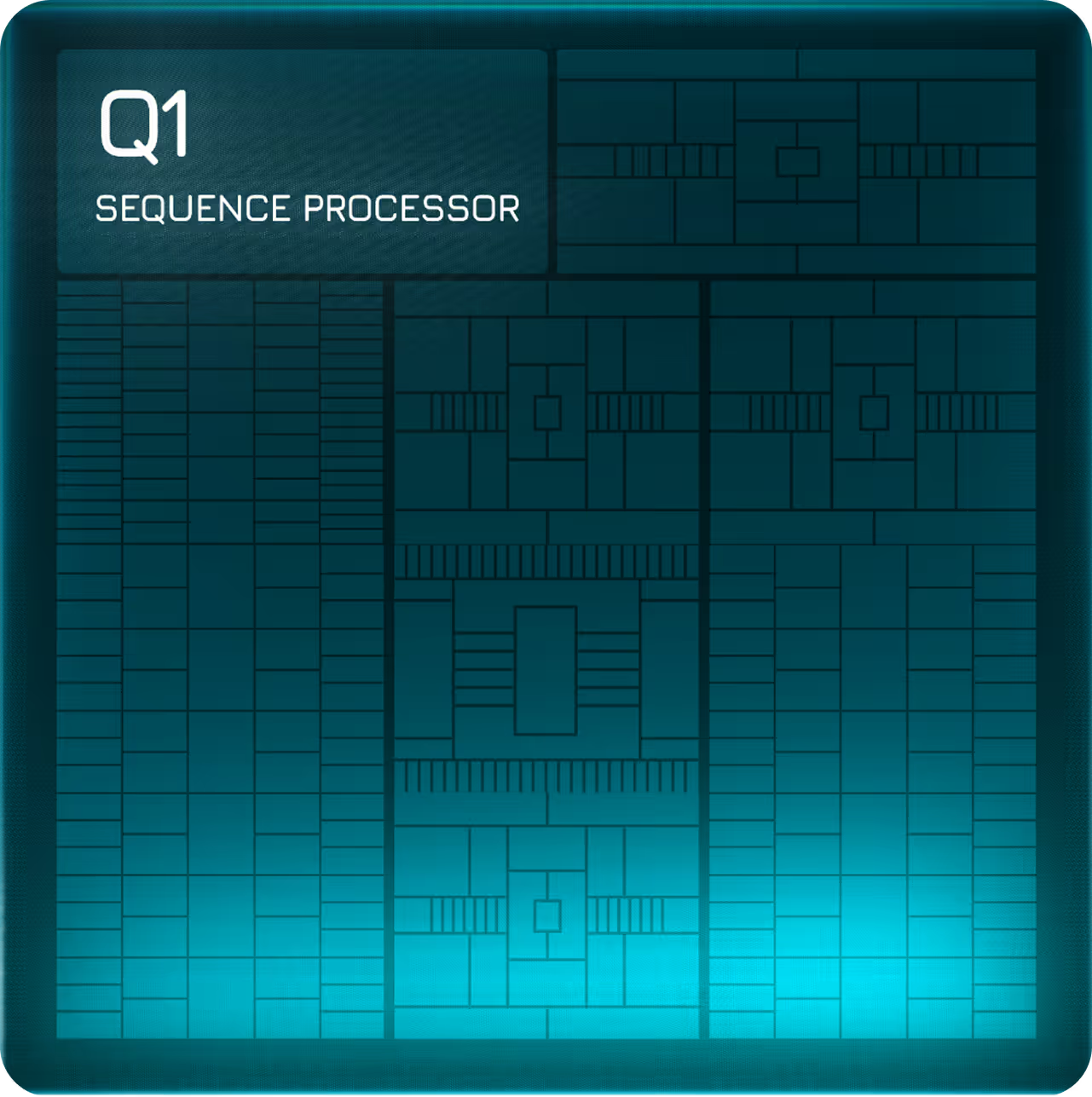
LINQ runs at the Q1ASM assembly layer, giving teams direct, low-level access to every sequence processor in the Cluster. Custom feedback logic, conditional branching, and pulse-level tuning can be written and iterated without waiting on a vendor roadmap to expose a new primitive.
Real-time feedback vs. near-time processing
Quantum error correction and other conditional operations must be completed inside the qubit's coherence time. In a control stack, that separates processing into two categories:
Near-time operations
Runs on classical computers between circuits, typically on millisecond timescales.
- Used for tasks such as recalibration and circuit compilation
- Handles much of the control stack’s classical processing
- Suitable for operations that do not need to complete before the qubit decoheres
Real-time feedback
Operates within a fixed latency budget determined by the physics of the qubit.
- Runs the complete measure-decode-correct loop in hardware
- No host computer mid-loop
- Avoids the timing variability introduced by a software round trip
Throughput at scale
As quantum systems grow, backplane throughput matters as much as latency. LINQ provides the bandwidth needed to keep feedback scaling with increasing syndrome data volumes.
2 Gb/s
Throughput per Cluster
25x
The requirement for a Surface Code-161
Scale linearly across Clusters

< 650 ns
Fast feedback. Scalable throughput.
The same architecture that closes a feedback loop in under
650 ns also scales to support the syndrome data volume of larger quantum error-correction codes.
650 ns also scales to support the syndrome data volume of larger quantum error-correction codes.
Where does real-time LINQ make a difference?
A measurement is discriminated on the readout sequencer, sent over LINQ, and used to trigger a conditional action.
Parallel active reset
Five qubits reset in parallel from a Cluster-wide broadcast in under 511 ns end to end, with no isolated-to-parallel latency cliff.
Quantum error correction
Ancilla syndrome data delivered to Riverlane's Deltaflow 2 QEC system via QECi, correction returned to the data qubits, demonstrated at code distances 3, 5, 7, and 9.
Qubit frequency tracking
Closed-loop drift correction via dispersive readout or Ramsey probes with feedback latencies down to 420 ns (configuration dependent).
Calibration via golden-section search
Real-time qubit calibration algorithm that runs on the Q1 sequencer to correct environmental drift and reach higher gate fidelities.
Entanglement heralding
Photon arrivals timestamped at up to 1/128 ns resolution on the QTM, with feedback at 230 ns on the the Low-Latency Path (LLP) or 994 ns on the TDC path.
Conditional branching
Execution path changes dynamically on mid-circuit measurement results, enabling adaptive circuits and protocols like quantum teleportation.
Frequently Asked Questions
What is LINQ?
LINQ is the deterministic communication network in the Qblox Cluster. It connects up to 120 Q1 sequence processors per mainframe, letting any sequencer share measurement data and conditional triggers with any other, in or across modules, with bounded latency and no host computer in the path.
How fast is LINQ's feedback loop?
Any conditional operation closes Cluster-wide in under 650 ns, a fully loaded figure covering simultaneous multi-qubit readout, all-to-all branching, and real-time parameter updates across up to 20 modules, entirely in hardware, backed by 2 Gb/s of throughput per link.
What is the difference between real-time and near-time feedback?
Real-time means an operation completes within a guaranteed window inside the qubit's coherence time. It's a property of determinism, not just speed. Near-time operations, like recalibration and circuit compilation, run on classical computers between circuits, on millisecond timescales. Real-time feedback has to run in hardware to hit its fixed latency budget.
What is QECi?
QECi is the industry-standard interface for connecting control hardware to third-party decoders. LINQ supports QECi natively, so syndrome data can reach any QECi-compliant decoder without custom engineering.
Which qubit platforms does LINQ support?
Superconducting qubits, spin qubits, trapped ions, neutral atoms, and colour centres. The modular Cluster architecture lets modules combine to match a given platform, and the same LINQ feedback model applies across all of them.
Does LINQ require a specific decoder or QEC code?
No. Nothing in the implementation is hardcoded to a single code, decoder configuration, or workflow. LINQ delivers syndrome data to any QECi-compliant decoder, and the demonstrated integration with Riverlane's Deltaflow 2 QEC system covers code distances 3 to 9.
How is the 6.886 µs round-trip latency measured?
It's the round trip time on the Surface-17 code (code distance 3), from syndrome extraction to conditional correction: all 8 ancilla qubits are read out simultaneously, the results are aggregated into a syndrome word over LINQ, that word is forwarded to the Riverlane Deltaflow 2 QEC system over QECi, and the correction is returned to the drive sequencers. Qblox's own contribution to that total is 1.114 µs and stays nearly flat as code distance increases, reaching 1.220 µs at Surface-161 (code distance 9).
Can LINQ connect to HPC and GPU resources?
Yes. Q1 sequence processors connect to NVIDIA NVQLink, extending the LINQ feedback model to GPU-accelerated compute under CUDA-Q, opening a path to GPU-based decoding and hybrid quantum-classical co-processing.
How many sequencers can participate in a feedback loop?
Up to 120 Q1 sequence processors per mainframe communicate over the LINQ fabric. Multiple Clusters can be daisy-chained, extending both the SYNQ timing protocol and the feedback model, with throughput scaling linearly per added Cluster.
How much throughput does LINQ provide, and does it scale with system size?
LINQ provides 2 Gb/s of throughput per Cluster, a margin above 25 times the requirement for a Surface Code-161 at code distance 9. Throughput scales linearly as Clusters are daisy-chained, so larger codes add proportional headroom rather than eroding it.
Does LINQ require Qblox's own software, or can I write custom logic?
LINQ executes at the Q1ASM assembly layer, so teams can write and iterate custom feedback logic, conditional branching, and pulse sequences directly on the sequence processors, without being limited to a fixed set of vendor-defined operations.
Why do I need LINQ if I'm not doing QEC yet?
Active reset and qubit frequency tracking alone measurably speed up experiment cycles today. And because LINQ already runs the full QEC-ready feedback loop in hardware, hardware bought now stays capable when a QEC roadmap becomes a near-term priority, rather than needing to be replaced.
Discuss LINQ for your QEC roadmap
Whether you run an academic laboratory or an industrial quantum computing programme, the Qblox specialist can walk you through how LINQ fits your qubit platform, code family, and decoder strategy.
TALK WITH A SPECIALIST


