


.svg)

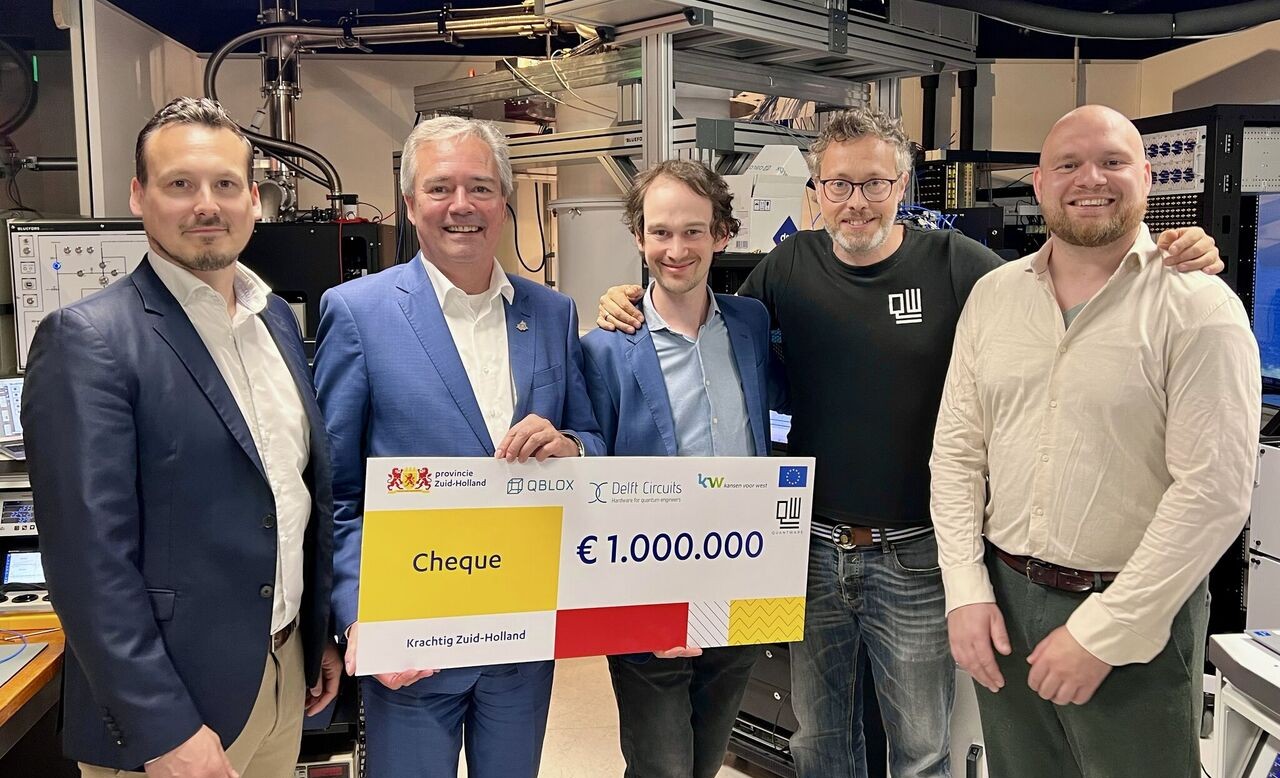
Achieving state-of-the-art two-qubit gate fidelity in superconducting qubit systems requires every layer of the quantum stack to perform at its limit.That is the challenge Project HAVIK is built around. Funded by the Kansen voor West (KvW) program with €1 million and co-financed by the European Union, Project HAVIK brings together Qblox, QuantWare, and Delft Circuits, three Delft-based quantum hardware companies working under QuantWare's lead to close the gap between component-level performance and system-level gate fidelity
What is two-qubit gate fidelity and why does it define quantum progress?
Two-qubit gate fidelity is not owned by any single layer of the quantum stack. It is a systems-level quantity that emerges from the interaction of the entire control and hardware chain.
At its core, two-qubit gate fidelity quantifies how accurately a quantum processor executes entangling operations on pairs of qubits. Every error source in the system contributes to the final number: decoherence in the qubit, noise in the control pulses, signal distortion in the cabling, thermal leakage between lines. Push fidelity high enough and you meet the threshold requirements for quantum error correction (QEC). Fall short and fault-tolerant computation remains out of reach.
This is the core argument for the Project HAVIK. Optimizing one layer in isolation will not move the number enough. Meaningful improvements emerge only through coordinated co-design across the full stack.
Full-stack integration across three partners
Project HAVIK is structured around the principle that real-world quantum performance is a system property. Each partner optimizes within its own domain, and the results are measured at the system level. In doing so, HAVIK validates the Quantum Open Architecture (QOA) approach, demonstrating that independently developed components can interoperate at the fidelity levels required for scalable quantum systems.
Qblox's modular, scalable control stack is responsible for generating the precise microwave pulses that drive qubit operations. Even marginal noise in those pulses degrades gate fidelity across the entire system. Within HAVIK, Qblox is refining pulse quality to support the highest-fidelity two-qubit gate operations achievable with today's superconducting hardware.
QuantWare is leading the project and optimising its superconducting qubit architecture to improve control over qubit-qubit interactions, a key variable in gate performance.
Delft Circuits is addressing cable thermalisation and signal crosstalk in the cabling infrastructure that connects the control electronics to the quantum processor, ensuring signal integrity from room temperature all the way to the millikelvin stage.
Together, the three partners cover the complete signal path: from control electronics through cabling to the qubit processor.
€1M KvW Investment: Backing the Delft Quantum Cluster
The €1 million KvW investment in Project HAVIK is a signal as much as it is a funding decision. The Kansen voor West program targets regional innovation with strategic economic impact, and backing a three-company quantum hardware integration project reflects a clear read on where the Delft ecosystem stands.
Co-funded by the European Union, this investment supports a genuine concentration of quantum expertise in the Netherlands, and KvW is betting that translating that expertise into validated, system-level hardware performance is how it stays competitive in the global quantum race. Beyond the technical results, the funding supports the high-skilled engineering talent and shared knowledge infrastructure that quantum advancement at scale will require.
Why pulse quality is a gate fidelity bottleneck?
Qblox has been building quantum control electronics since the earliest days of the Dutch quantum ecosystem. Qblox’s control stack is designed from the ground up for scalability and modularity — enabling researchers and quantum hardware developers to go from few-qubit experiments to multi-QPU architectures without redesigning their control infrastructure.
The Qblox Cluster is built around an analog front-end engineered for ultra-low 1/f noise and phase stability across the full system. The QCM module's ultra-low 1/f noise performance directly supports high-fidelity two-qubit gate execution by improving coherence and overall experimental accuracy. Signal generation covers baseband up to 18.5 GHz, with each channel delivering greater than 800 MHz instantaneous bandwidth and short rise times to maintain strong time-domain pulse performance.
Timing is equally critical. Qblox's proprietary SYNQ protocol guarantees sub-nanosecond synchronization across all channels, with picosecond-level jitter and phase coherence maintained across the full Cluster mainframe. For two-qubit gate operations, where relative pulse timing between control and target channels determines the interaction, this level of synchronization is not a convenience feature. It is a prerequisite. Qblox
Beyond raw signal quality, integrated numerical filters including IIR, FIR, and exponential filters correct signal distortions before they reach the QPU, preserving waveform integrity at the qubit input. Real-time waveform parametrization of amplitude and gain, combined with dynamic phase and frequency modulation, enables flexible and precise signal shaping without round-trips to the host PC, keeping latency out of the control loop.
Within HAVIK, Qblox is pushing this hardware further. The goal is to reduce control electronics noise contributions to the point where they are no longer the limiting factor in system-level gate fidelity, leaving qubit coherence and processor architecture as the variables that determine the final benchmark.
A United European Initiative
This initiative is made possible through the vital funding and support of the European Union. By backing the HAVIK project, the EU fosters critical collaboration across the quantum ecosystem, uniting specialized leaders in qubit design, control electronics, and cryogenic infrastructure. This targeted European investment is essential to overcoming the primary hardware bottlenecks in quantum development.

Next steps
The HAVIK team is already underway. First significant results are expected in 2026, with the full project concluding in early 2027.
Qblox and the participating partners will continue to publish updates and share progress as major technical and experimental milestones are reached.

.png)

