


.png)
.svg)

Why Is the Spin Industry Shifting to Fully Baseband Spin Qubit Control?
Fully baseband control of spin qubits is moving from a theoretical convenience to a scaling requirement. The original Loss-DiVincenzo proposal for quantum computation with quantum dots already envisaged operating spins with baseband voltage pulses. Resonant microwave control then became the workhorse for high-fidelity single-qubit gates. But it carries a scaling cost that the field now names explicitly. Integrating high-frequency oscillating signals, qubit crosstalk, and on-chip heating all worsen as the array grows, as set out in the Science report on baseband hopping control.
The deeper issue is structural. As Vandersypen and colleagues argued in their review of the spin qubit wiring and interconnect bottleneck, individual DC, pulsed, and microwave signals must currently be routed from room temperature to every qubit inside a sub-kelvin cryostat. Each microwave line, micromagnet, and bias-tee removed from the per-qubit budget is wiring, heat, and crosstalk removed from the fridge.
That is the pressure pushing the leading encodings toward all-electrical, baseband operation. It relocates the hard problem onto the room-temperature electronics, which must keep the full baseband chain clean, phase-coherent, and deterministically timed across a fast-growing channel count.
Baseband-Controllable Platforms
The convergence is visible across encodings that share almost nothing at the device level.
- Exchange-only qubits
Encoding a logical qubit in three spins, the Si/SiGe approach demonstrated by HRL achieves universal logic with only baseband voltage pulses, bypassing microwave-associated crosstalk entirely. The cost is gate depth: an arbitrary single-qubit gate takes on the order of four exchange pulses and a two-qubit gate more than a dozen, with leakage out of the computational subspace to manage. - Hopping-based control
Demonstrated in a 2D germanium array, baseband hopping control drives single-spin rotations by hopping holes between dots with site-dependent quantization axes, reaching single-qubit fidelities of 99.97%, coherent fidelity shuttling of 99.992%, and two-qubit gates of 99.3%, all without high-frequency drive. - High spin-orbit germanium hole spins
Since the first germanium hole spin qubit, strong and electrically tunable spin-orbit coupling has enabled fast all-electrical EDSR with Rabi frequencies beyond 1 GHz, and all-electrical four-qubit logic in which exchange is pulsed to program multi-qubit operations.
Three different mechanisms, one electronics requirement. As the microwave layer thins, fidelity comes to rest on the precision, noise floor, and timing of the baseband stack.
How Does Coherent Spin Shuttling Drive Scaling as a Baseband Operation?
There is a second reason baseband matters more every year, and it appears the moment connectivity, rather than single-qubit speed, becomes the bottleneck. Direct-coupling architectures suffer wiring fan-out and crosstalk as they scale, which is why conveyor-mode shuttling architectures propose sparse arrays linked by moving electrons between manipulation sites. Whether implemented as bucket-brigade transfer or as conveyor-mode translation of a moving dot, shuttling is executed with shaped gate-voltage sequences. The mechanism that scales the processor is itself a baseband operation, and it has now been shown to preserve spin coherence, including coherent spin shuttling through germanium.
That collapses a distinction the field used to take for granted. Shuttling shares a control plane with manipulation and readout, so its fidelity is governed by the same low-frequency noise, timing determinism, and ground integrity that set gate fidelity. Treating it as one more baseband primitive, handled inside the same coherent envelope as control and readout, is what turns a unified control stack from a convenience into a scaling requirement.
Why Does Fragmented Control Instrumentation Limit Qubit Fidelity?
The conventional stack distributes the work across precision DC sources, pulse generators, vector signal generators, and the mixers and filters that bridge them, each with its own clock, noise floor, latency, and grounding. At a handful of qubits the patchwork is tolerable. At scale, two problems dominate.
The first is spectral discontinuity: every mixer or filter sitting at a DC-to-baseband boundary distorts the waveform, and that distortion lands on the pulse shapes and from there on the gate fidelity. The second is noise. Spin qubit coherence is frequently charge-noise-limited, with low-frequency electrical fluctuations on the gates translating directly into dephasing. A DC source that drifts, or a bias line that picks up mains-frequency interference, spends the same fidelity budget that the qubit physics is trying to protect. That points to the quietest and most fundamental constraint of all, which is where the equipment is grounded.
Ground Loops: Why DC And Microwave Control Are Kept Apart?
Anyone who has built one of these setups knows the unwritten rule: keep the DC source-measure units well away from the microwave control units. The reason is grounding. Co-locating sensitive DC sourcing with high-power microwave control invites ground loops. The 50/60 Hz pickup and low-frequency noise that follow are fatal to the sub-microvolt stability a quantum dot potential needs, and to the coherence a charge-noise-limited gate depends on.
That rule sits in direct conflict with everything above. Fully baseband control wants DC sourcing, baseband generation, and readout living in one synchronized system; good grounding practice wants them as far apart as possible. The tension cannot be resolved by sliding more instruments into one rack. The signal ground itself has to be rethought.
All You Need In A Single Mainframe: The Qblox DC Cluster
The Qblox DC Cluster is built around that constraint. Within a single mainframe, it delivers phase-coherent signal generation from DC to 400 MHz, merging the traditionally separate domains of biasing, pulsed control, and readout while preserving the ground-loop isolation that normally forces those domains apart. Supporting up to 20 modules, it locks every channel to a single clock source through SYNQ synchronization. This lets the DC Cluster scale with increasingly complex device architectures while keeping feedback loops short, with LINQ-based feedback supported across the same mainframe.
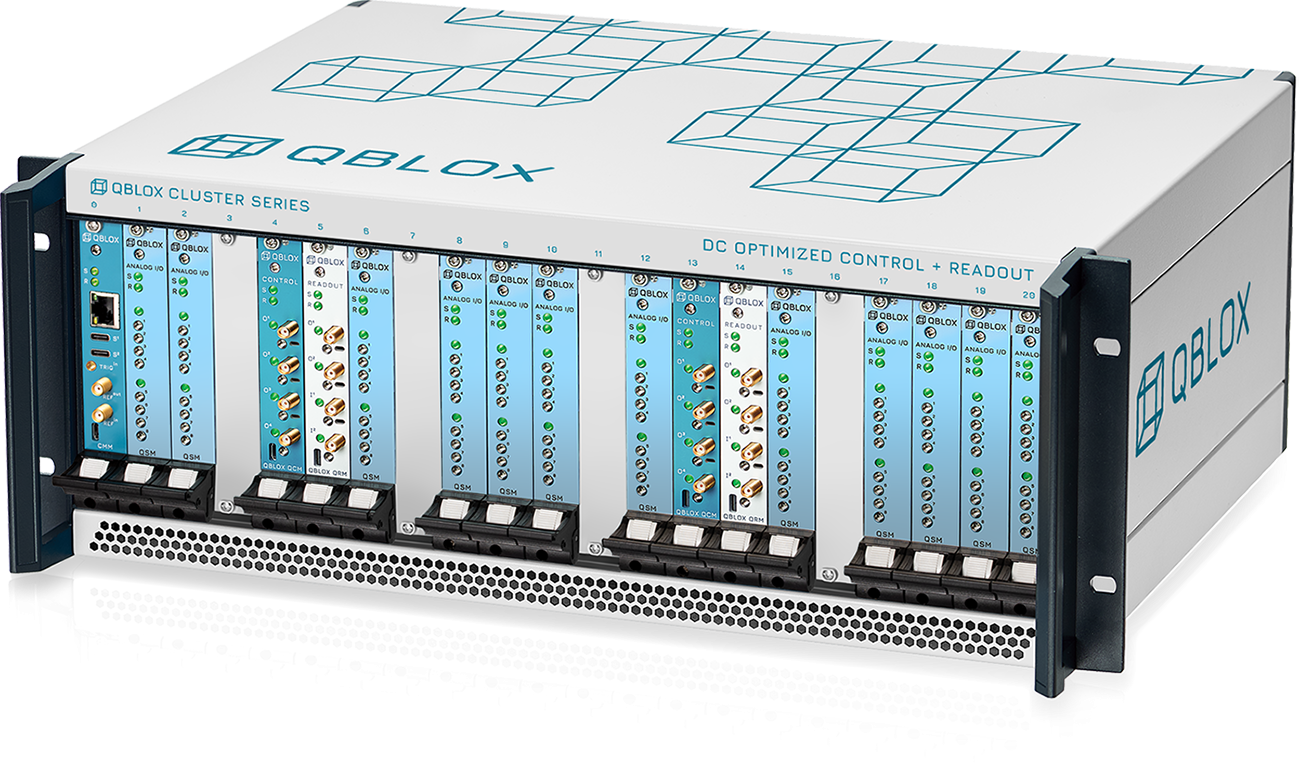
Modular Design For Full Baseband Control And Readout
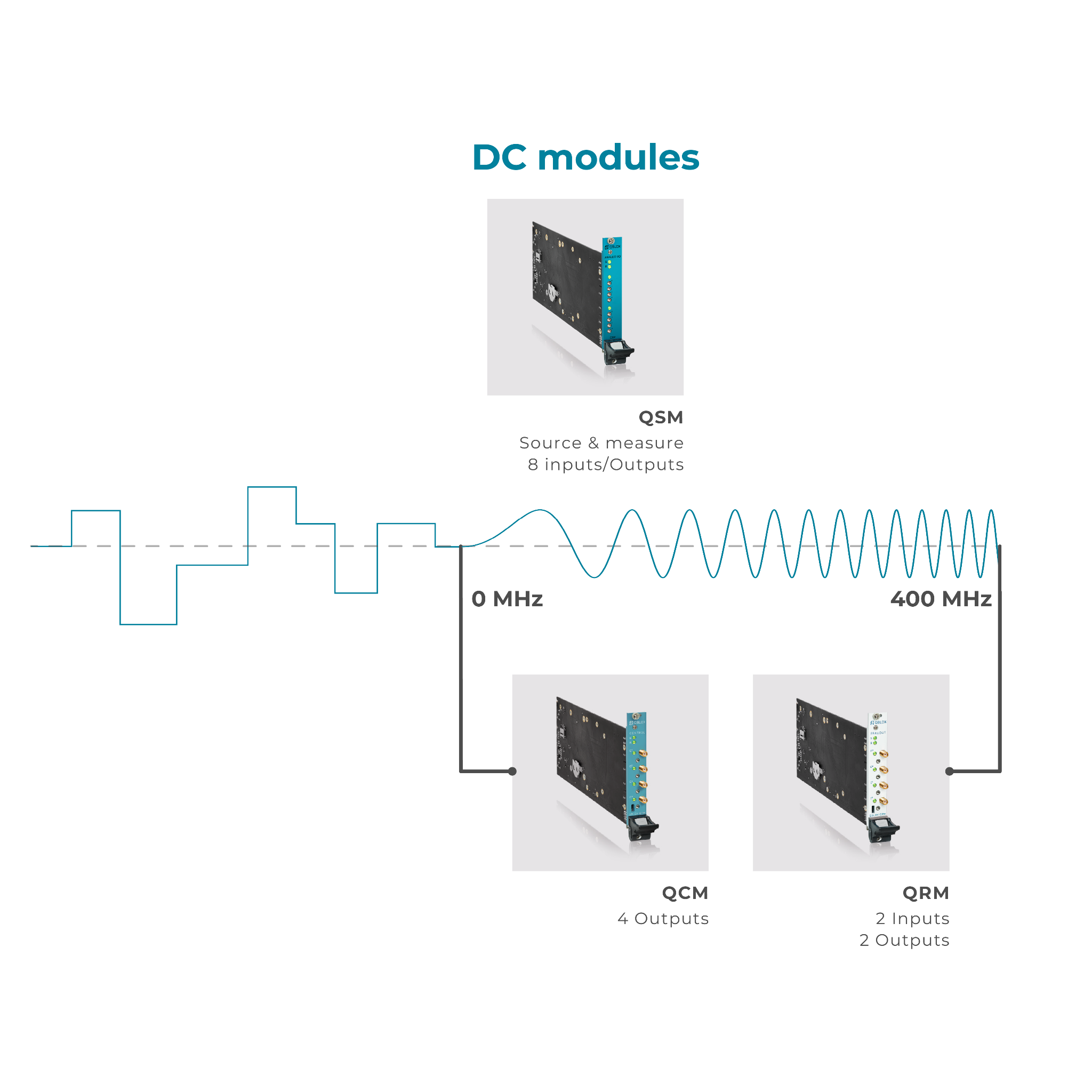
The Qblox DC Cluster, a single integrated mainframe can perform the full experimental cycle, with each module optimized for a specific task:
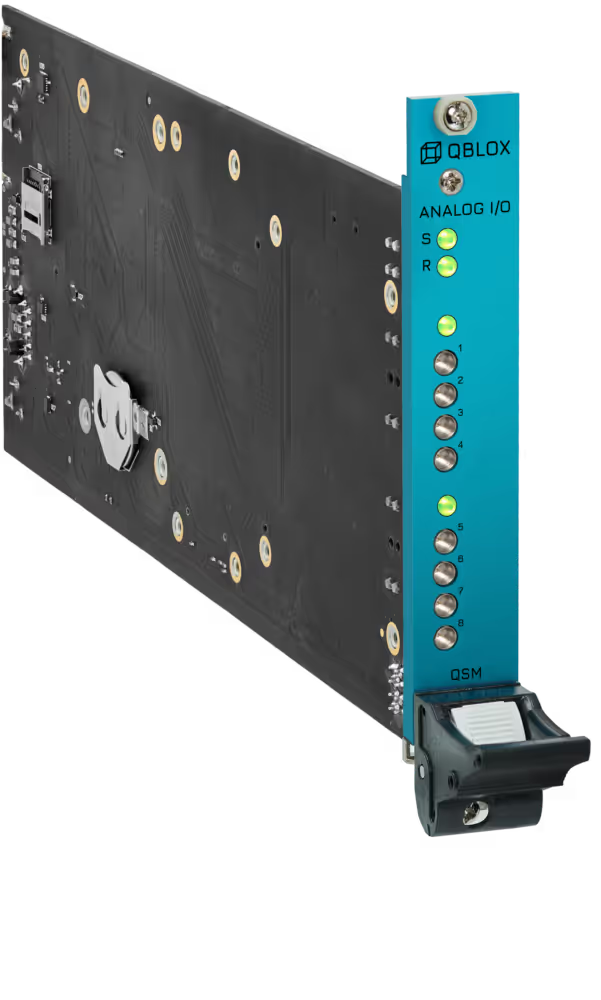
- Define and tune quantum dots with precise DC gate voltages using the Quantum Source and Measurement (QSM) module. The QSM reaches 28-bit effective resolution with a step size below 0.6 µV across a ±10 V range, resolves current down to 0.5 pA (up to 50 mA), and runs fast voltage sweeps with a 1.3 µs rise time. Simultaneous leakage-current detection flags gate breakdown, and a safety ramp-down protects the device against transients, giving stable electrostatic confinement in long-term operation.
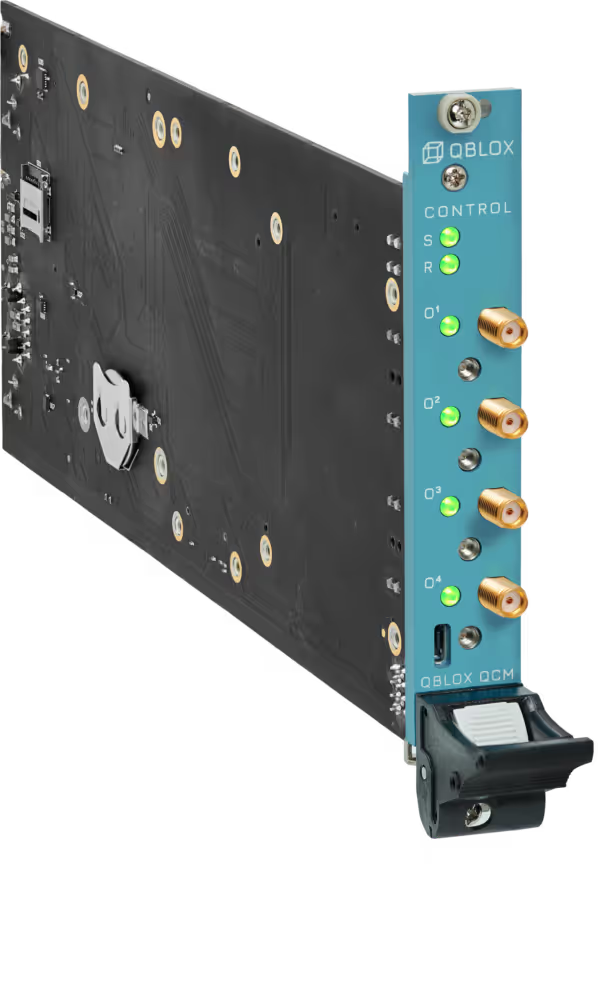
- Drive coherent spin rotations using baseband electric-dipole pulses generated by the Qubit Control Module (QCM). Its four low-noise output channels, 0–400 MHz range, and real-time waveform generation with distortion correction enable fast, precise manipulation of qubit states.
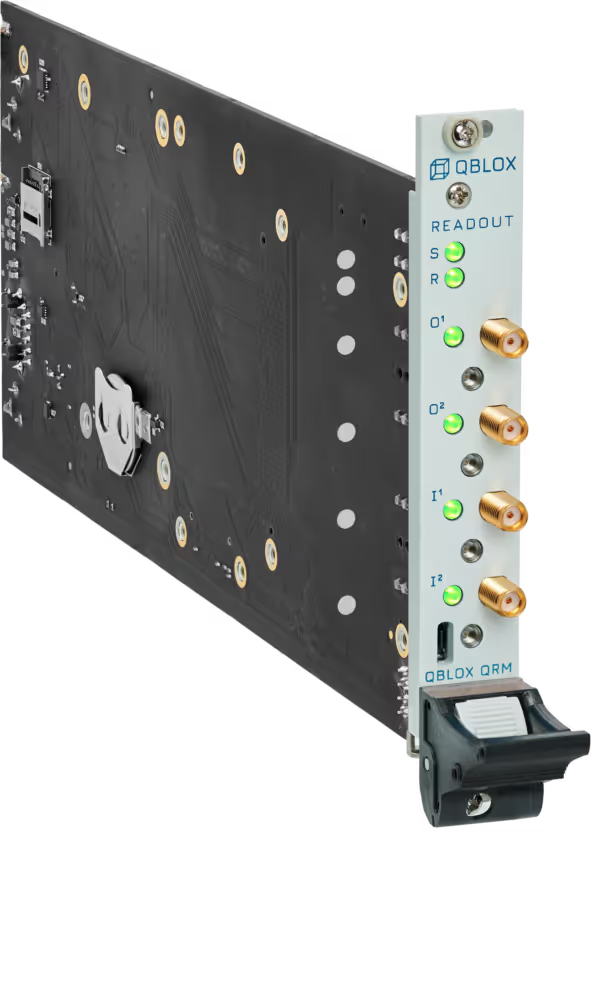
- Perform dispersive gate-based readout by RF reflectometry using the Qubit Readout Module (QRM). With two output and two input channels, onboard data processing, and 0–400 MHz coverage, the QRM allows high-fidelity measurement without switching instruments, maintaining the coherence of the overall sequence.
- Correlate and analyze timing-sensitive measurements across all channels, thanks to the phase-coherent synchronization provided by the DC Cluster. All operations are digitally defined and hardware-synchronized, eliminating calibration drift, timing skew, and inter-instrument interference.
All these operations run on a single integrated mainframe, digitally defined and hardware-synchronized. By eliminating calibration drift, timing skew, and inter-instrument interference, the DC Cluster enhances signal-to-noise ratio, reduces latency, and directly improves key qubit metrics such as (T2*) and single-gate fidelity.
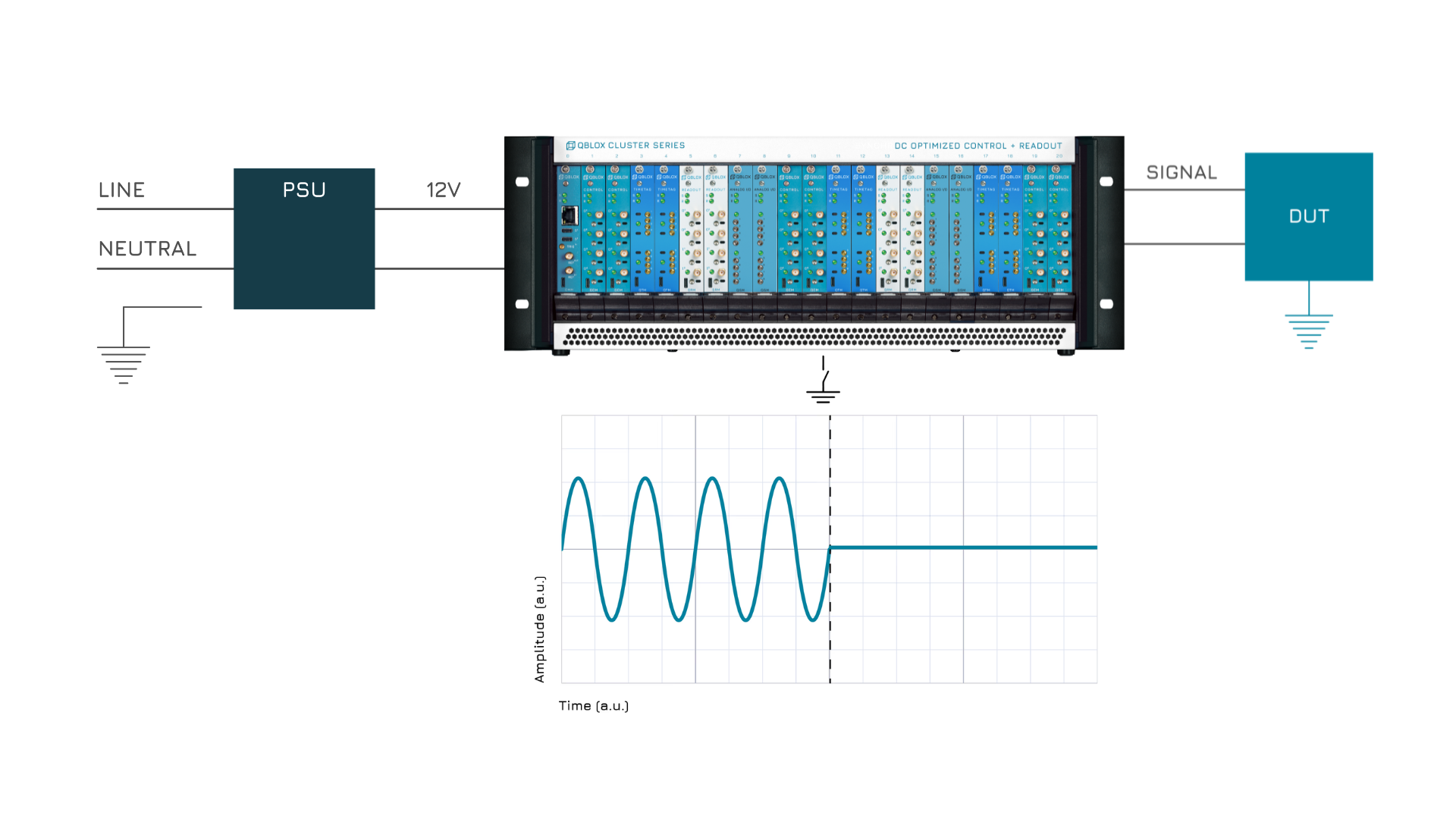
Ground-Loop-Free Baseband Control And Readout
What lets all of this share one mainframe is the DC Cluster's ground-loop-free design. Each QSM channel carries an internal grounding switch to toggle between source mode and ground, removing the need for an external breakout box. Crucially, the mainframe isolates this signal ground from the mains earth. That isolation removes 50/60 Hz mains interference and its harmonics from the signal path, the dominant low-frequency noise source whenever sensitive DC sourcing shares a rack with baseband control. With the interference eliminated at its origin, the baseband control and readout modules (QCM and QRM) can operate inside the same DC Cluster on a common ground. This delivers the long-term stability that charge-noise-limited spin qubits depend on, without the recalibration that ground loops would otherwise force.
How Do You Scale Your Quantum System From a Single Device to a Spin Qubit Array?
In practical terms, the DC Cluster transforms day-to-day experimentation. A typical measurement sequence on a double quantum dot, covering initialization and tuning, qubit rotations, reflectometry readout, and feedback-adjusted pulse sequences, can run with the QSM, QCM, and QRM housed in one mainframe. Consolidating these modules into a single unit removes inter-instrument hand-offs and shrinks the system footprint, which is what makes scaling to larger qubit counts practical. The ground-loop-free design lowers the low-frequency noise floor that single-gate fidelity and T2* depend on.
The modularity of the Qblox’s DC Cluster also supports scaling to multi-qubit arrays: multiple mainframes can be synchronized to extend the number of channels without compromising timing determinism. As arrays grow, baseband shuttling between sites becomes a routine operation rather than a special case, and keeping it phase coherent with control and readout is far simpler when all three live in the same system. For platforms where spin dynamics, shuttling, and charge sensing are tightly intertwined, that integration is what turns into a repeatable, coherent process.
When a Spin Qubit Platform Finds Its Control Partner
Whatever the encoding, exchange-only, hopping-based, or high spin-orbit, the spin qubit platforms with the clearest path to scale ask the electronics for the same thing: fully baseband control and readout that stay coherent, stable, and ground-loop free.
The Qblox DC Cluster provides the matching control foundation: a single coherent mainframe covering the full baseband spectrum from DC to 400 MHz, designed from the ground up for quantum experiments where timing, phase, and fidelity are inseparable.
By unifying bias, control, and readout within one synchronized system, and by doing so without sacrificing ground-loop isolation, the Qblox DC Cluster is the perfect match for all spin qubit devices.
If your platform is heading in that direction, that is the conversation worth having.
Start eliminating ground loops with the Qblox’s DC Cluster today!
Frequently Asked Questions
What does fully baseband control of spin qubits mean?
It means driving the qubit operations, manipulation, inter-qubit coupling, and readout, with signals in the baseband, from DC up through a few hundred megahertz, instead of relying on resonant microwave drive. Exchange-only encodings, hopping-based control, and high spin-orbit platforms such as germanium hole spins can all be operated this way through gate voltages.
Why does microwave control scale poorly for spin qubits?
Resonant control requires routing high-frequency oscillating signals to every qubit, which adds wiring, increases qubit crosstalk, and dissipates power as heat inside a sub-kelvin cryostat. Baseband control offer a much cleaner path forward by minimizing these overheads, making them a primary driver behind hopping-based and exchange-only operation.
Why is coherent spin shuttling considered a baseband operation?
Spin shuttling moves electrons between quantum dots using shaped gate voltage pulses. Because these voltage sequences operate from DC up to a few hundred megahertz without a carrier frequency, they are classified as baseband signals. Consequently, shuttling performance is highly sensitive to low frequency noise, ground loops, and timing synchronization. Managing shuttling within the same integrated baseband stack ensures the sub nanosecond timing and pristine noise floors needed to preserve spin coherence during the move.
Why are DC source units normally separated from microwave control?
Placing sensitive DC sourcing next to high-power readout signals creates ground loops, and the resulting 50/60 Hz pickup and low-frequency noise degrade sub-microvolt quantum dot stability and gate coherence. The two domains are traditionally kept apart to protect signal integrity, which is the barrier an integrated baseband platform has to overcome.
How does the Qblox DC Cluster enable integrated baseband control and readout?
The DC Cluster physically decouples the signal ground from the mains earth, eliminating 50/60 Hz interference and the ground-loop barrier that forces DC and baseband apart. That lets DC source-measure units, baseband signal generation, and timetagging share one synchronized, ground-loop-free system, with sub-microvolt precision, low 1/f noise, and deterministic synchronization for scalable feedback.



.avif)
.png)

