.svg)

The Quantum Internet Alliance (QIA), a European partnership of more than 50 institutions led by TU Delft, has received €47.5 million in new funding from the European Commission. The funding will advance QIA's work on a full-stack quantum internet prototype and prepare it for real-world deployment. As a QIA partner, Qblox will continue to develop the quantum control hardware that helps make that prototype a reality.
Key takeaways
- The Quantum Internet Alliance (QIA) has received €47.5 million from the European Commission for its second phase (SGA2).
- SGA2 covers 42 months of research and development, building on the first phase (SGA1), which ran from October 2022 to March 2026.
- The goal is a complete, programmable full-stack quantum internet prototype capable of running quantum network applications.
- A key milestone is interconnecting two metropolitan-scale quantum networks via a long-distance fibre link using quantum repeaters.
- Qblox is developing the control stack and hardware interface that connect these long-distance networks.
What QIA achieved in its first phase (SGA1)
The new Specific Grant Agreement (SGA2) builds on the consortium's first phase (SGA1), which ran from October 2022 to March 2026. During SGA1, QIA expanded its European platform for quantum internet development, integrating hardware, software and networking research while laying the technological foundations for a prototype quantum network.
As a world-leading quantum control electronics company, Qblox contributed to this foundation by developing control hardware for quantum network nodes.
Connecting networks over long distances
SGA2 supports the next 42 months of research and development. Over these 3.5 years, QIA will focus on combining its technologies into a complete, programmable quantum network prototype capable of running quantum network applications.
A key milestone is demonstrating how two metropolitan-scale quantum networks can be interconnected via a long-distance fibre link using quantum repeaters, a critical step toward large-scale quantum communication. In this phase, Qblox is developing the control stack and hardware interface that connect these long-distance quantum networks.
"Over the past years, we have developed the core building blocks of a quantum internet. Our mission in this next phase is to integrate these components into a full stack quantum internet prototype. Europe is at the very forefront of quantum internet technologies world-wide, and this prototype may become the first of its kind in the world," said QIA Director Stephanie Wehner.
From the lab to real-world quantum internet applications
The programme will also take first steps towards the Quantum Internet Initiative by transitioning quantum networking technologies from laboratory experiments to real-world applications. This includes initial preparations for quantum internet pilot facilities and open-access infrastructure for researchers, developers and companies. QIA's full-stack effort also covers advancing use cases of quantum network technologies, and provides a platform for all quantum internet efforts across Europe to connect and join forces.
QIA is already delivering impact beyond the lab. Technologies developed within the programme have moved to products, and new startups are emerging from the QIA ecosystem, ready to translate QIA's breakthroughs into practical products and services.
"Right now, Europe is still at the forefront of quantum internet efforts worldwide," Wehner added. "With this second phase, we are creating technology that does not yet exist anywhere on earth. But to remain ahead, it is critically important that in addition to the second phase of this R&D project, QIA's startups can now move to the realisation of proof-of-concept use cases, we empower the ecosystem by making open access facilities available, and we further strengthen Europe's technological capabilities and create the conditions for a vibrant quantum ecosystem that can compete globally," she concluded.
Who is building Europe's quantum internet
Qblox is one of more than 50 partners in QIA, alongside leading research institutions such as TU Delft / QuTech, the Fraunhofer ILT, ICFO, and CEA; telecom operators including Telefónica, Telecom Italia and Cellnex; industry players such as Thales, SAP and TOPTICA; and fellow quantum companies including QphoX, Welinq, Q*Bird and Delft Networks. See the full list of members.
The QTM: from QIA research to product
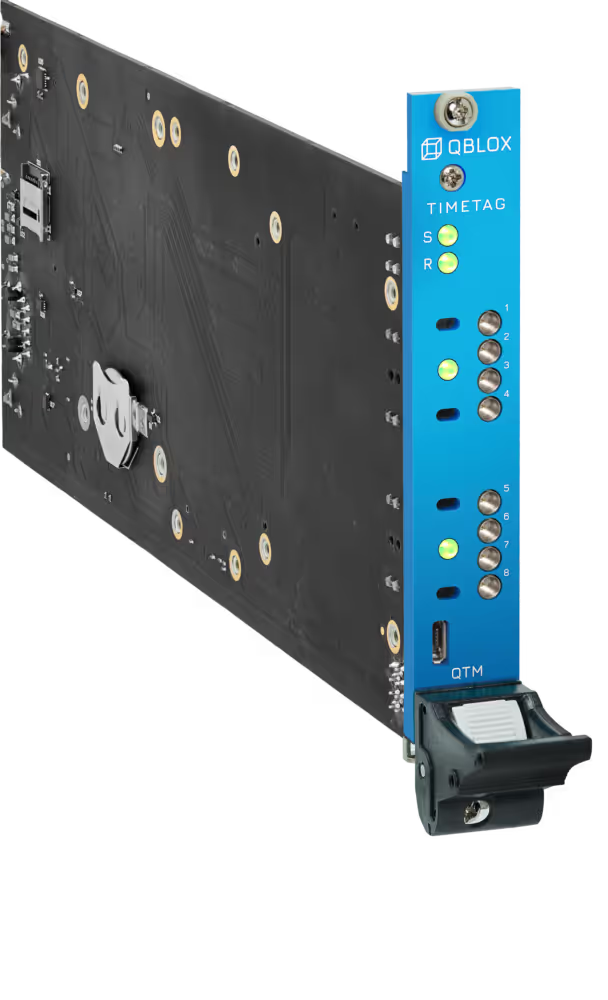
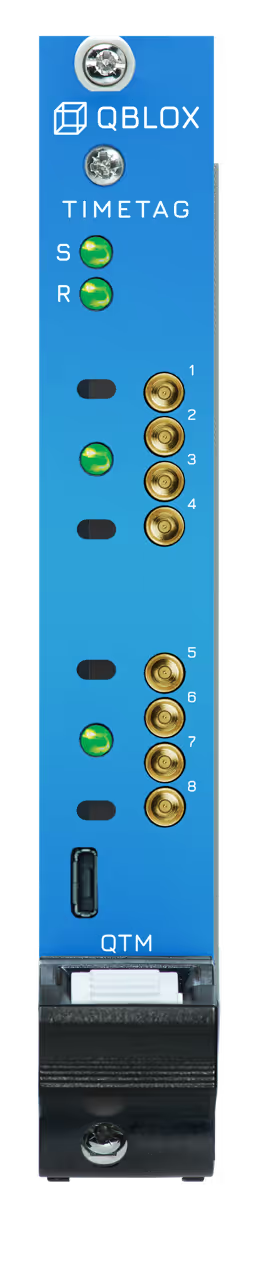
Our Qubit Timetag Module (QTM) is one of the examples of QIA research becoming a product.
Quantum network experiments depend on digital signal generation, time tagging and readout working together. The QTM combines all three in a single instrument, simplifying quantum network experiments on NV centre, rare-earth-ion and trapped-ion platforms.
This product development won the QIA Innovation Award at the 2024 PI+ Meeting. Read more here.
About the Quantum Internet Alliance
The European Quantum Internet Alliance (QIA) is a partnership of 50+ world-leading institutions on a mission to build a global Quantum Internet made in Europe. By combining QIA’s diverse interdisciplinary team, QIA drives an innovative European platform for Quantum Internet development. In the near-term, QIA builds a full-stack prototype network that has the potential to become the first of its kind in the world.
Led by TU Delft, QIA currently consists of academic institutions, telecom operators, system integrators and quantum technology start-ups across 12 European member states.
For more information, visit www.quantuminternetalliance.org.
Frequently asked questions
What is the Quantum Internet Alliance (QIA)?
QIA is a European partnership of more than 50 institutions, led by TU Delft, on a mission to build a global quantum internet made in Europe. Its members include academic institutions, telecom operators, system integrators and quantum technology startups across 12 European member states.
How much funding has QIA received for its second phase?
QIA has received €47.5 million from the European Commission under the Specific Grant Agreement 2 (SGA2), covering 42 months of research and development.
What will QIA build in its second phase?
QIA will integrate its technologies into a complete, programmable full-stack quantum internet prototype. A key milestone is interconnecting two metropolitan-scale quantum networks via a long-distance fibre link using quantum repeaters.
What is Qblox's role in QIA?
In the first phase, Qblox developed control hardware for quantum network nodes. In the second phase, Qblox is developing the control stack and hardware interface that connect long-distance quantum networks.
What is the Qblox Qubit Timetag Module (QTM)?
The QTM is a Qblox instrument that combines digital signal generation, time tagging and readout in a single instrument. Developed with QIA partners for NV centre, rare-earth-ion and trapped-ion platforms, it won the QIA Innovation Award at the 2024 PI+ Meeting.

.png)