
WHITEPAPER
Fast Scalable Feedback for Quantum Error Correction and Advanced Qubit Operations
LINQ closes the full quantum error correction feedback loop in hardware, in under 650 nanoseconds, Cluster-wide, with no host computer in the path.
Download whitepaper

Download Free Whitepaper

Fill in your details
Complete the short form.

Check your inbox
Receive the LINQ whitepaper directly by email.
THE PROBLEM
Every Quantum Error Correction Cycle Is a Race Against Decoherence
LINQ closes the full quantum error correction feedback loop in hardware, in under 650 nanoseconds, Cluster-wide, with no host computer in the path.
Every QEC cycle requires a measurement-decode-correct loop that completes within microseconds, deterministically, at data rates that grow quadratically with code distance.
Miss the window, and errors accumulate faster than they're corrected.
INTRODUCING LINQ
A Deterministic Feedback Protocol,
Built Into the Hardware
LINQ connects up to 120 Q1 sequence processors per mainframe over a shared fabric, moving data wherever the feedback loop needs it: on chip, across modules, or Cluster-wide, with no host computer in the path.
Miss the window, and errors accumulate faster than they're corrected.
download whitepaper
WHY LINQ
Three Reasons LINQ Is Different
#1
Deterministic, not just fast
Bounded, guaranteed latency on every operation, a fixed number of clock cycles in firmware, every time.
#2
Built ahead of the demand curve
A 2 Gb/s backplane carries the 80 Mb/s syndrome stream of a distance-9 surface code with more than 25× headroom, and throughput scales linearly as Clusters are added.
#3
Deterministic, not just fast
Qblox and Riverlane integrated a real decoder into the Qblox control stack through an open interface, and measured the results across code distances 3 through 9. LINQ also extends to NVIDIA's NVQLink for GPU-accelerated co-processing.
The full breakdown is in the whitepaper
download whitepaper
ONE ARCHITECTURE
Six Protocols, One Architecture
Protocol #01
Deterministic active reset
Protocol #02
Surface code quantum error correction
Protocol #03
Active qubit frequency tracking
Protocol #04
Calibration via golden-section search
Protocol #05
Bayesian parameter estimation
Protocol #06
Heralded entanglement
FROM THE TEAM
The People Behind the Performance
“What changed for us wasn't a single number, it was not having to think about the control layer at all. Active reset, calibration, error correction: they all just run, deterministically, every time.”

David Vos
Quantum Application Engineer
“Every protocol we've built on LINQ such as active reset, qubit's parameter tracking, calibration, entanglement heralding, all of them shares the same fabric and the same guarantees. That consistency is what actually lets quantum tech advance fast.”

Vatshal Srivastav
Lead Quantum Application Engineer
“We didn't want to publish another latency number without showing our work. This whitepaper shows exactly where the time in a QEC cycle goes, and why the control layer isn't what holds you back.”

Francesco Battistel
Roadmap Leader, Quantum Error Correction
SCALABILITY
Built to Scale
Hardware latency is decoupled from code complexity: Qblox's own contribution stays a small, stable fraction of the total reaction time from distance 3 to distance 9.
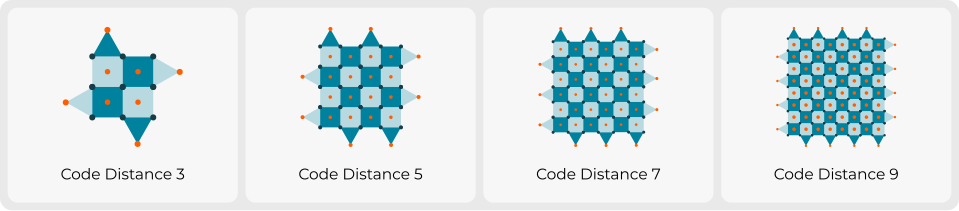
The same modular control electronics, the same backplane bandwidth per unit, and the same deterministic routing guarantees apply at every point along the roadmap toward fault-tolerant quantum computing.
Authors
Bilal Kalyoncu
Product Marketing Manager
David Vos
Quantum Application Engineer
Vatshal Srivastav
Lead Quantum Application Engineer
Francesco Battistel
Roadmap Leader, Quantum Error Correction

Daniela Ivanova Huisman
Technical Writer
See the full latency and throughput data
download whitepaper


