.svg)

A fully integrated spin qubit setup spanning the complete hardware and software stack.
A dedicated lab for spin qubits
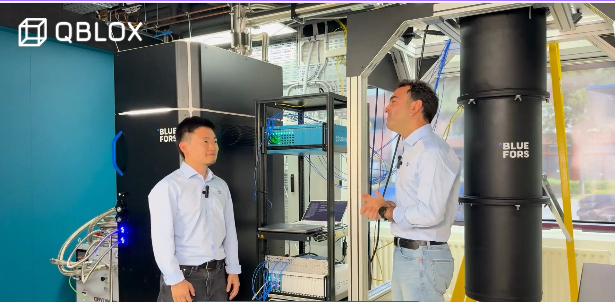
Qblox Spin Qubit Lab is a fully integrated spin qubit setup at Qblox’s headquarters in Delft, The Netherlands. The lab spans the complete hardware and software stack, from the dilution refrigerator and the quantum dot device to the control electronics and the automation software running on top.
The lab serves several purposes at once. It is a testbed for validating Qblox hardware and software with a real spin qubit device, a demonstrator of a complete measurement setup in operation, a benchmarking platform for new firmware and application examples, and a site for internal research and development. The setup is already operational: the fridge is cold, a device is mounted, and measurements are running.
The motivation behind the lab is practical. Spin qubit experiments come with specific requirements around scalability, fast feedback and low noise qubit control and readout. By having a spin qubit lab in-house, Qblox engineers can develop, test, and debug measurement solutions in the lab environment the users work in.
Funded through ARCTIC and SCALLOP
The Spin Qubit Lab is funded through two major European initiatives.
The first is ARCTIC (Advanced Research on Cryogenic Technologies for Innovative Computing), a Chips Joint Undertaking project that brings together industrial partners, research and technology organisations, and academic institutions across Europe to advance cryogenic technologies for computing.

The second is SCALLOP (Scalable Hardware for Large-Scale Quantum Computing), funded by the European Innovation Council. SCALLOP targets the hardware challenges of scaling quantum processors beyond today's device sizes.

Both programmes define the research objectives, collaboration framework, and funding structure under which the lab operates. Through ARCTIC and SCALLOP, Qblox collaborates with leading European companies, research organisations, and universities to accelerate spin qubit technology. The lab is already demonstrating early integration of partner technologies: a device from SemiQon is currently under measurement, in the Bluefors fridge, with automated tune-up provided by QuantrolOx software.
Inside the fridge: a Si-MOS quantum dot device
At the heart of the setup is a silicon MOS quantum dot device provided by project partner SemiQon, mounted inside a Bluefors dilution refrigerator and measured at base temperature. Silicon MOS is one of the leading material platforms for spin qubits, offering compatibility with semiconductor manufacturing processes and long coherence times.
The lab is not limited to a single device type. Additional lines are being installed to accommodate larger devices, and the team plans to measure a range of device architectures and material systems, including Si/SiGe and germanium-based platforms. This breadth matters: it ensures that the Qblox hardware and software offering is validated across the material systems and device architectures the spin qubit community actually works with.
Control electronics built for spin qubits
The spin device is controlled by Qblox control electronics. The spin qubit device is controlled by the Qblox’s Cluster and the DC Cluster. This setup brings ultra-stable DC sourcing, baseband control, and readout together in a single synchronised system. The Cluster provides fully synchronized, multi-channel microwave signal generation and acquisition, with every channel locked to a single clock source via SYNQ and LINQ technology. Fast scalable feedback across modules is a prerequisite for many-qubit spin systems, where real-time decisions such as initialisation verification and mid-circuit measurement depend on low-latency and high-throughput communication between control channels.
Spin qubit coherence is frequently charge-noise limited, which is why sensitive DC sourcing and high-power control electronics are traditionally kept in separate racks: co-locating them invites ground loops, and the resulting mains pickup undermines the stability a quantum dot potential requires. The DC Cluster resolves this tension with a ground-loop-free design that removes mains interference at its origin, so the full signal chain can operate on a common ground within one instrument.
In the Spin Qubit Lab, the complete experimental cycle runs from this single integrated stack: quantum dot tuning, coherent spin manipulation, and gate-based readout, all digitally defined and hardware-synchronised with the fast feedback that many-qubit spin systems depend on. Eliminating calibration drift, timing skew, and inter-instrument interference directly improves the metrics that matter for spin qubits, and the same architecture scales as the lab moves to larger arrays and new material systems.
Software: from application examples to automated tune-up
Software development is one of the main activities in the lab. Qblox has developed spin qubit tailored application examples using Qblox Scheduler, its high-level control software. These examples cover common spin qubit measurement routines and are published in the Qblox documentation. The lab is where these examples are tested against a real device and refined based on actual experimental requirements, so that users receive workflows that have been validated on working hardware rather than written in the abstract.
On top of the Qblox software stack, QuantrolOx provides automated tune-up and characterisation of the quantum dot device. Automated charge stability mapping and dot tuning reduce the time from cooldown to a working qubit, a bottleneck that grows quickly with device size. This joint operation demonstrates early integration of partner technologies within the ARCTIC and SCALLOP framework and shows how a modular, open software stack can combine tools from specialised vendors.
Why an in-house spin qubit lab matters
Spin qubits are advancing rapidly as a platform for scalable quantum computing, driven by their small footprint, long coherence times, and compatibility with semiconductor fabrication. Control electronics and software need to keep pace with that progress. An in-house lab gives Qblox a direct feedback loop:
- Validation on real devices: New firmware, hardware designs, and application examples are benchmarked against a working quantum dot device before they reach users.
- Seamless qubit operation: Maintain complete control over your quantum environment, giving you a reliable platform to run complex spin qubit measurements and confidently diagnose system behavior.
- Partner integration: Devices, software, and components from European partners are integrated and tested within a single operational stack.
- Customer demonstrations: Researchers and technology decision-makers can see a complete spin qubit measurement setup in operation, from fridge to software.
Together with the Qblox Qubit Lab for superconducting qubits, the Spin Qubit Lab extends Qblox's in-house testing infrastructure across the two most widely deployed solid-state qubit platforms.
Visit the Spin Qubit Lab
The Spin Qubit Lab is open to researchers, partners, and technology decision-makers exploring spin qubit control, device characterisation, and full-stack integration. If you would like to see a complete spin qubit measurement setup in operation, or discuss what spin qubit technology can enable for your research, get in contact to schedule a visit.
This work has received funding from the European Union through the ARCTIC project (Chips Joint Undertaking) and the SCALLOP project (European Innovation Council).