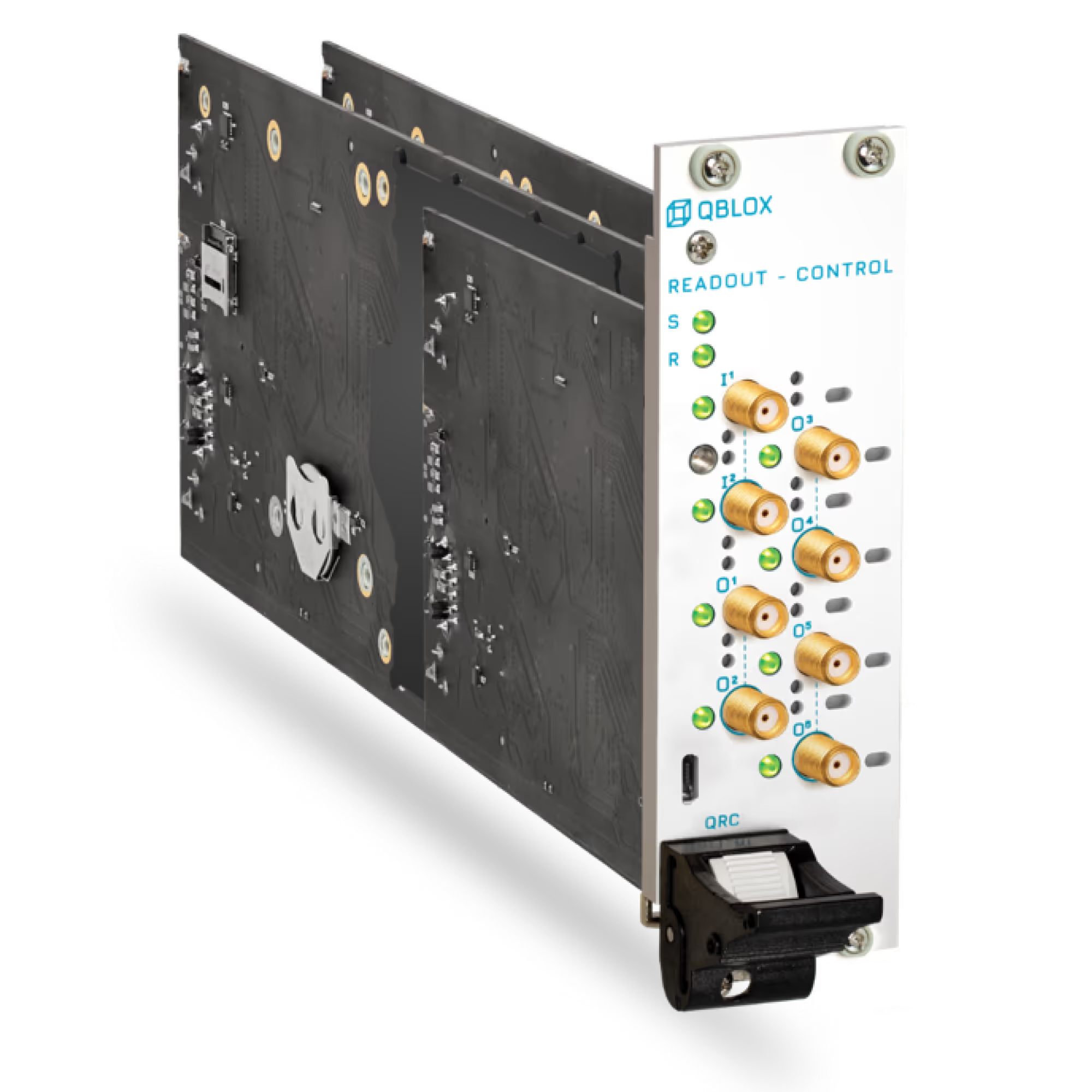
The Qubit Readout and Control (QRC) module sets a new standard for the readout and control of qubits in both research and high-performance computing.
The QRC is a high channel density RF solution that offers excellent performance and flexibility for controlling a growing number of qubits with the highest fidelities inside the Qblox control stack.

Scalable and modular
With 6 output and 2 input channels, the QRC interfaces with multiple qubits at once, supporting extensive signal requirements for superconducting, spin, and optically addressable qubits.

Excellent performance
Engineered on the state-of-the-art RFSoC technology, QRC ensures precise control with high gate fidelities through an excellent signal-to-noise ratio and low phase noise.

Fast time to results
Calibration-free operation and automatic signal path optimization enable rapid success. Seamless integration with the Qblox portfolio ensures synchronized ports and fast feedback across the entire stack.0
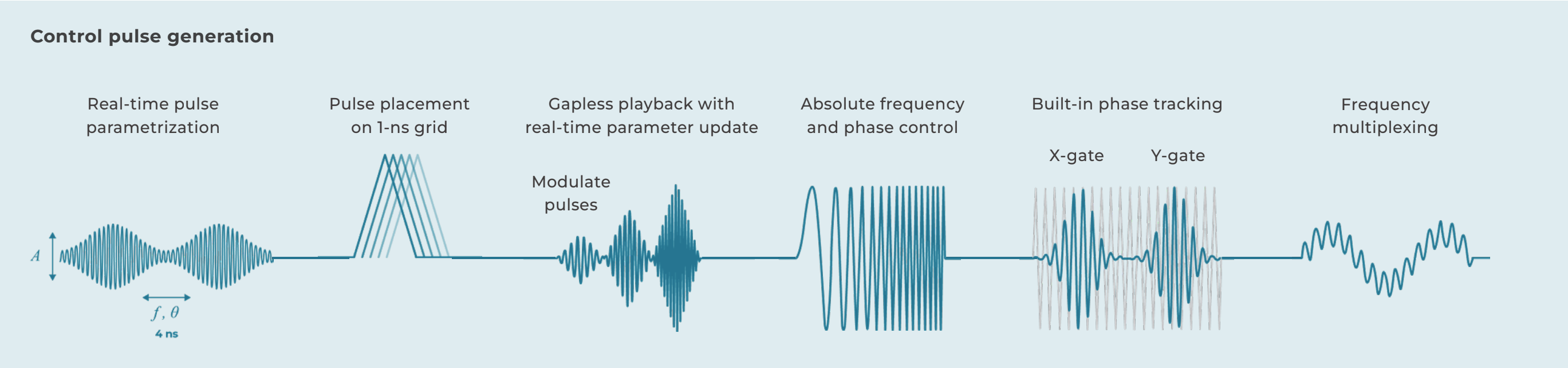

Fully independent ports with continuous frequency range from 100 MHz to 10 GHz offers generation of all signals for your qubits.

Channel-independent instantaneous bandwidth of >800 MHz is available across the full frequency range for frequency multiplexed operations.

The calibration-free unique conversion scheme seamlessly combines direct digital synthesis (DDS) and single mixing for optimal performance, achieving high spurious free dynamic range (SFDR) and high signal-to-noise ratio (SNR) in the full frequency range.

Unrivalled time-domain performance through short rise times and low ringing enable ultra-fast high fidelity gates.

The intuitive open-source software Qblox Scheduler enables easy scheduling of quantum experiments, while assembly layer access allows third-party integrations (e.g., Qiskit) and enhances experimental speed.

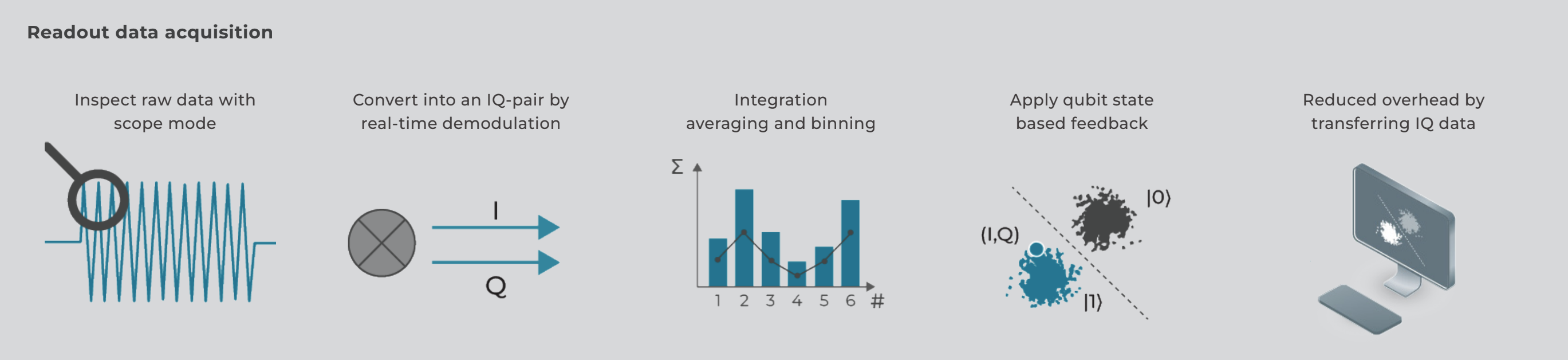
Integrate seamlessly into the Qblox control stack with the precise Q1 real-time sequencer and ensure fully deterministic operation for long pulse sequences and measurement loops.
What you program is what you get: gapless playback ensures full predictability and reliability of signals, crucial for phase coherent operations.

Create short parametrized pulses with the industry-fastest parameter update rate of 4 ns.

Get ultimate freedom of channel configurations with 12 independent sequencers, allowing modularity for control and readout ports to adapt to your experiment.
The Cluster mainframe hosts up to 10 QRC modules, counting up to 80 microwave channels within a single 19" rack for seamless scalability. The Cluster supports all signals needed for your qubit by synchronizing and linking the QRC with the complete Qblox Cluster portfolio.
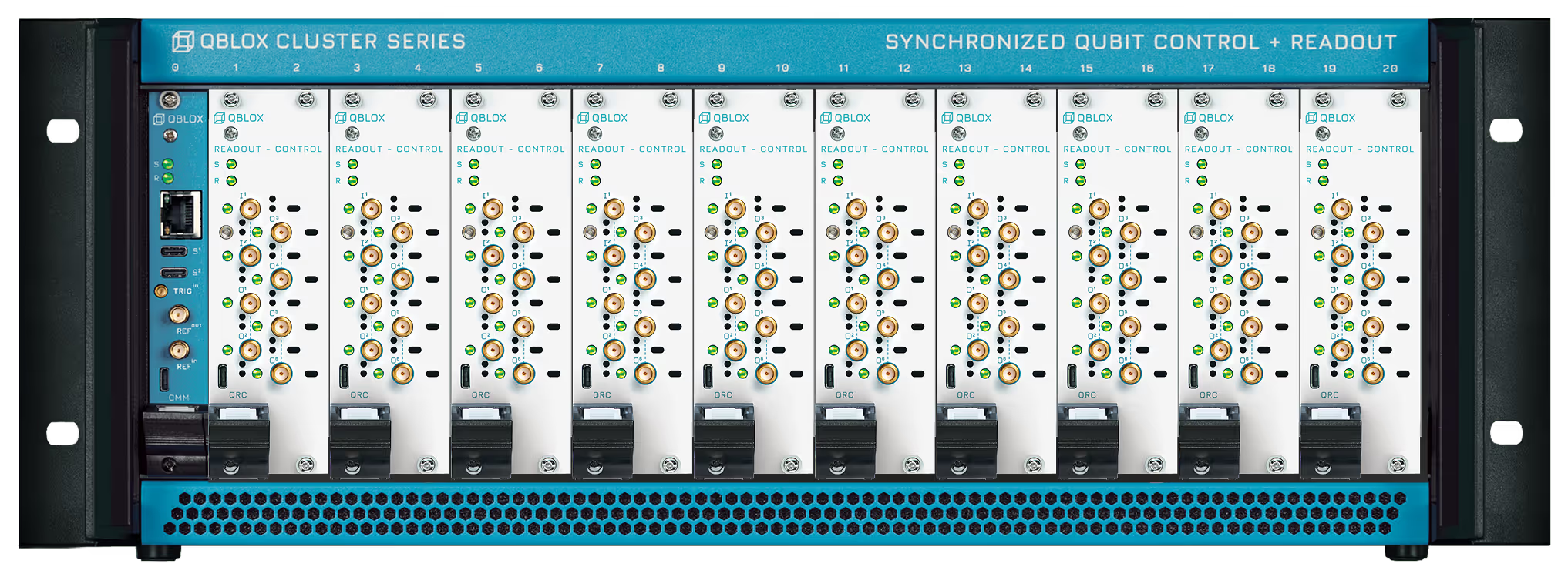

SYNQ protocol guarantees synchronization of all channels within < 1 ns with ps level jitter and great phase coherence for precise qubit control and the highest fidelities.

LINQ protocol establishes fast scalable feedback with all-to-all connectivity for conditional playback and conditional branching.
Superconducting qubits
QRC is the high-channel density solution for superconducting systems to seamlessly scale up to 100s of qubits.
- Provides an all-in-one solution for superconducting qubit control and readout, with each module supporting fully parallelized operations up to 5 qubits and a mainframe capacity of 50 qubits.
- Offers compatibility with a wide range of superconducting qubit types, including fluxoniums, transmons and cat qubits.
- Enables frequency-multiplexed readout up to 8 qubits on single feedline in the bandwidth of >800 MHz.
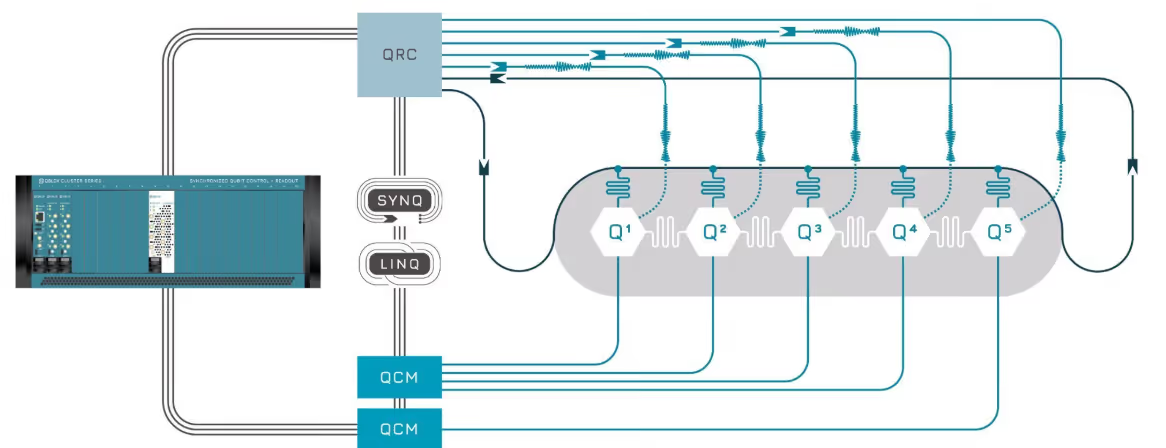
The QRC module is paired with the QCM module for flux pulse delivery, forming a fully integrated Cluster control stack solution for single and two qubit gates and resonator readout.
Spin qubits
QRC ensures precise signal processing to enable reliable and scalable spin-qubit systems.
- Provides improved sensitivity at lower noise and high speed by up to 8 multi-tone RF-reflectometry in a wide frequency range.
- Enables high-fidelity operations by pulse resolution on a 1 ns time grid.
- Provides a clean spectrum limiting undesired excitations and error injection in the system, thanks to high SFDR and SNR.
- Facilitates running long quantum circuits with limited dephasing over time due to high output and phase stability.
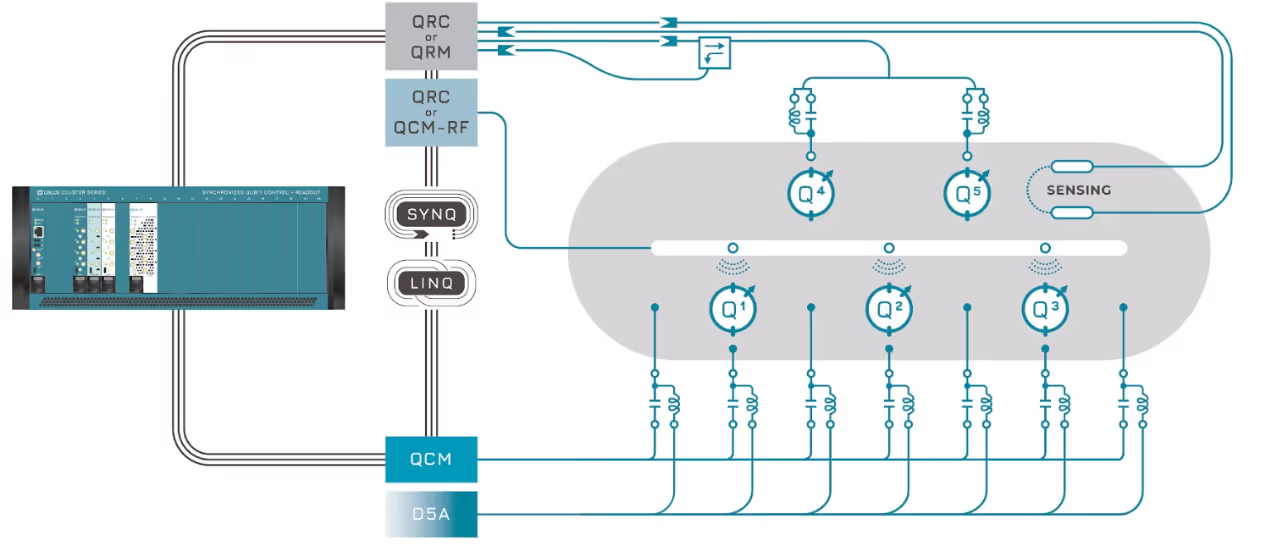
The QRC module is configured with other modules in the Cluster mainframe to obtain charge stability diagrams and drive qubit transitions while simultaneously supporting high-speed RF reflectometry measurements.
Optically addressable qubits
QRC is the solution for high quality multiplexed RF and MW control signals.
- Enables driving multiple qubits via a single antenna by QRC’s ability to output 8 tones per output channel.
- Provides full spin register control with automatic phase tracking, and together with QTM, optical transition readout by photon counting or time tagging for photon correlation experiments.
- Makes EOM sweeps over a broad range ideal by multiplexing without reducing output power per tone.
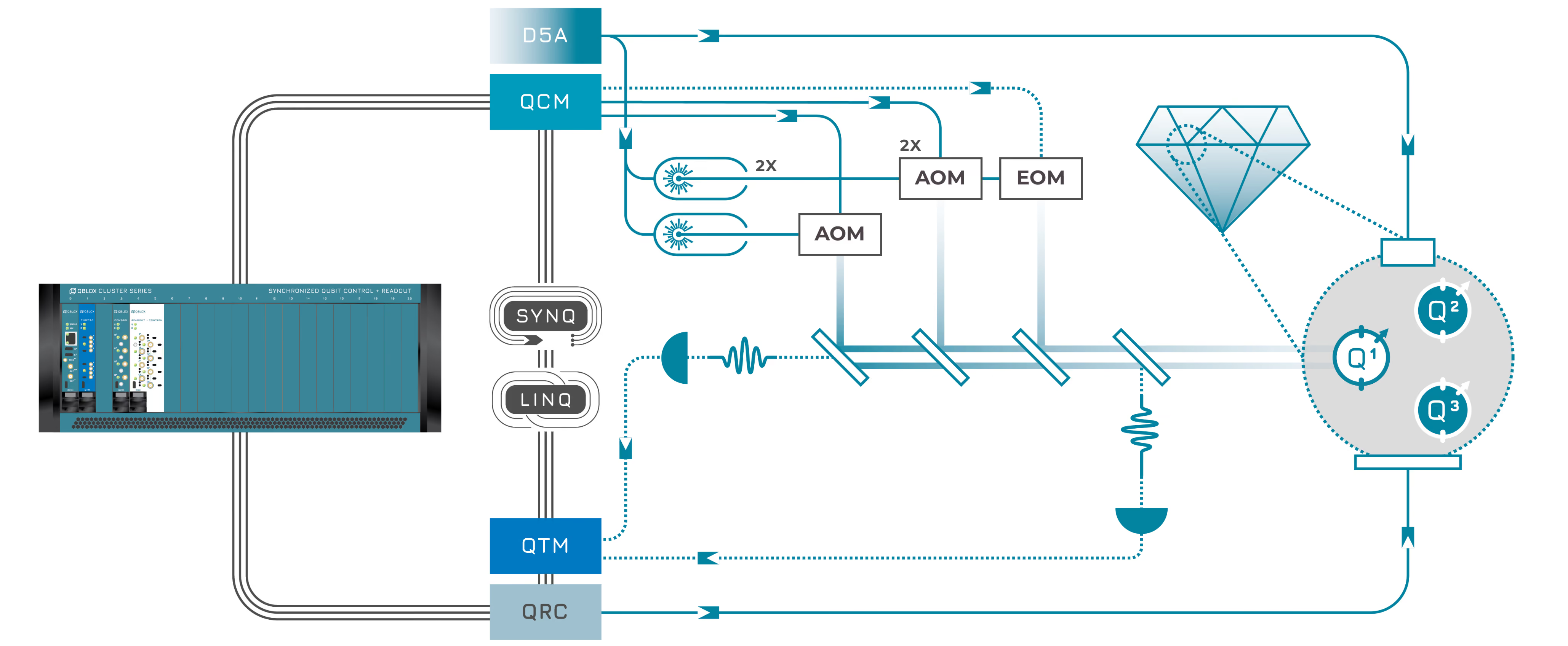
The QRC seamlessly integrates with the Qblox portfolio for color centers to combine qubit control, photon counting, and timetagging with feedback capabilities into a single mainframe.
OUTPUT CHANNELS
Number of output channels:
Max number of carrier frequencies per output channel:
SFDR (excluding harmonics):
Phase noise:
-108 dBc/Hz at a 10 kHz offset at 6 GHz.
Signal-to-noise ratio:
-150 dBc/Hz across the entire frequency range.
Number of digital outputs:
INPUT CHANNELS
Number of input channels:
Max number of carrier frequencies per input channel:
Input power at full ADC range:
Variable attenuator range:
GENERAL SPECIFICATIONS
Number of pulse processing units:
Parameter update rate
(Amplitude, offset, frequency, phase):
Connector type:
SMA for analog outputs / SMP for digital outputs
Reference clock:
10 MHz via Cluster mainframe or external clock
Dimentions single module:
Qblox B.V. - Delftechpark 22 | 2628 XH Delft | The Netherlands | Chamber of Commerce 72525053 | All rights reserved | sales@qblox.com