
QCM


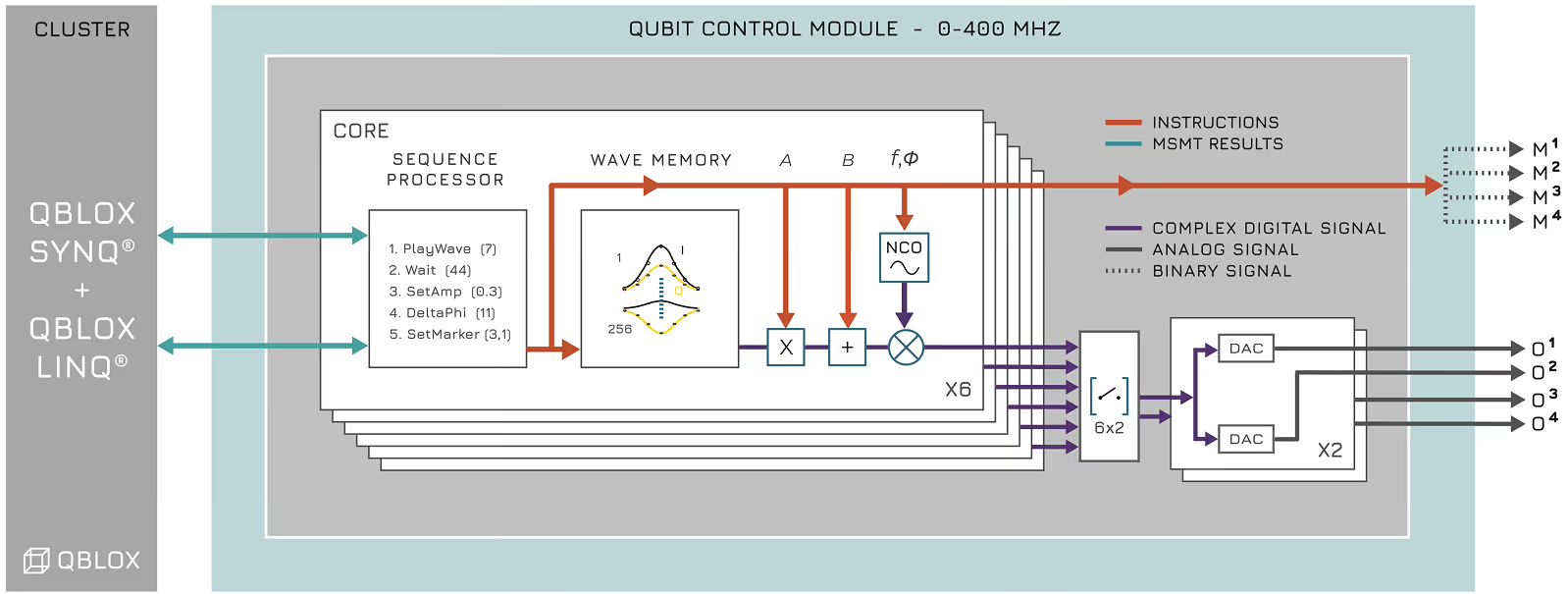
A Qubit Control Module (QCM) hosts 6 sequence processors for flexible multiplexed driving and tracking of up to 6 qubits (or other oscillators). The unleveled noise performance makes it ideal for high-fidelity single- and two-qubit control.
The extremely low offset and gain drift (a few ppm/K) avoid the need for frequent recalibration. This makes the QCM the ideal baseband signal generator to push gate fidelities to the next level.
Advanced sequencer capabilities drastically speed up characterization experiments (Spectroscopy, Rabi, Chevron, Charge-stability diagrams) by avoiding repeated wave uploading and large overhead in software-controlled loops.
During quantum algorithms, it allows for instance arbitrary single-qubit control (phase, amplitude) from a single pulse pair. Qubit phases can be tracked in real time using the NCOs which accept virtual Z-gates through phase updates from the sequence processor.
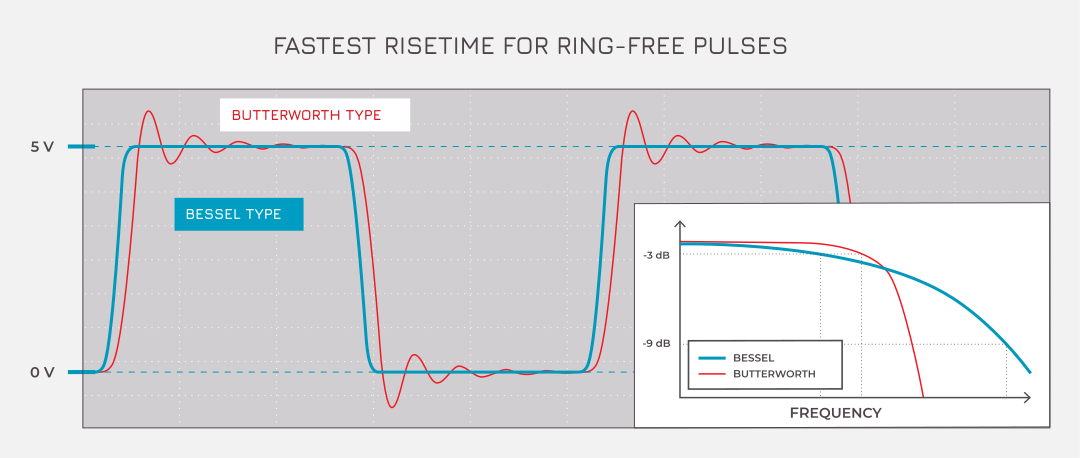
Cluster modules are equipped with Bessel type filters to generate ring-free pulses with fast rise time as required by quantum computing applications.
The commonly used Butterworth type filters (higher -3dB point) need further filtering to overcome the overshoot and ringing effects, which in turn results in longer rise times. Bessel type filters provide the sharpest step responses with a larger bandwidth beyond -3 dB point as illustrated in the figure.


400 MHz (-9 dB)
(in a 50 Ω load):
at 1 MHz
(in a 50 Ω load, 5 Vpp):
at 1 Hz
(in a 50 Ω load, 5 Vpp):
15-32 °C ambient: